Emergencies
Victorian Drains in Period Homes: Why Older Properties Block More Often
Interceptor traps, clay joints and no rodding access — why Victorian drainage systems block more often and what a modern survey reveals.
Published 19 July 2026
Richmond, Twickenham and Teddington are full of beautiful Victorian and Edwardian terraces. The original cornices, sash windows and tiled hallways are a genuine pleasure — but the drainage systems buried beneath those period floors and gardens can be a very different story. If you live in a pre-1920s property and suffer repeated blockages, you are not imagining things. The infrastructure was built for a different era, and it shows.
How Victorian Drainage Was Designed
Victorian engineers were not incompetent — they were working with the materials and knowledge of their time. Most domestic drainage from that period shares a handful of characteristics that create problems today.
Clay Pipe Construction
The vast majority of Victorian drain runs were laid in glazed vitrified clay, jointed with sand-and-cement mortar or, in earlier properties, a simple butt joint packed with putty. Clay itself is durable and largely inert, which is why so much of it is still in the ground. The problem is the joints.
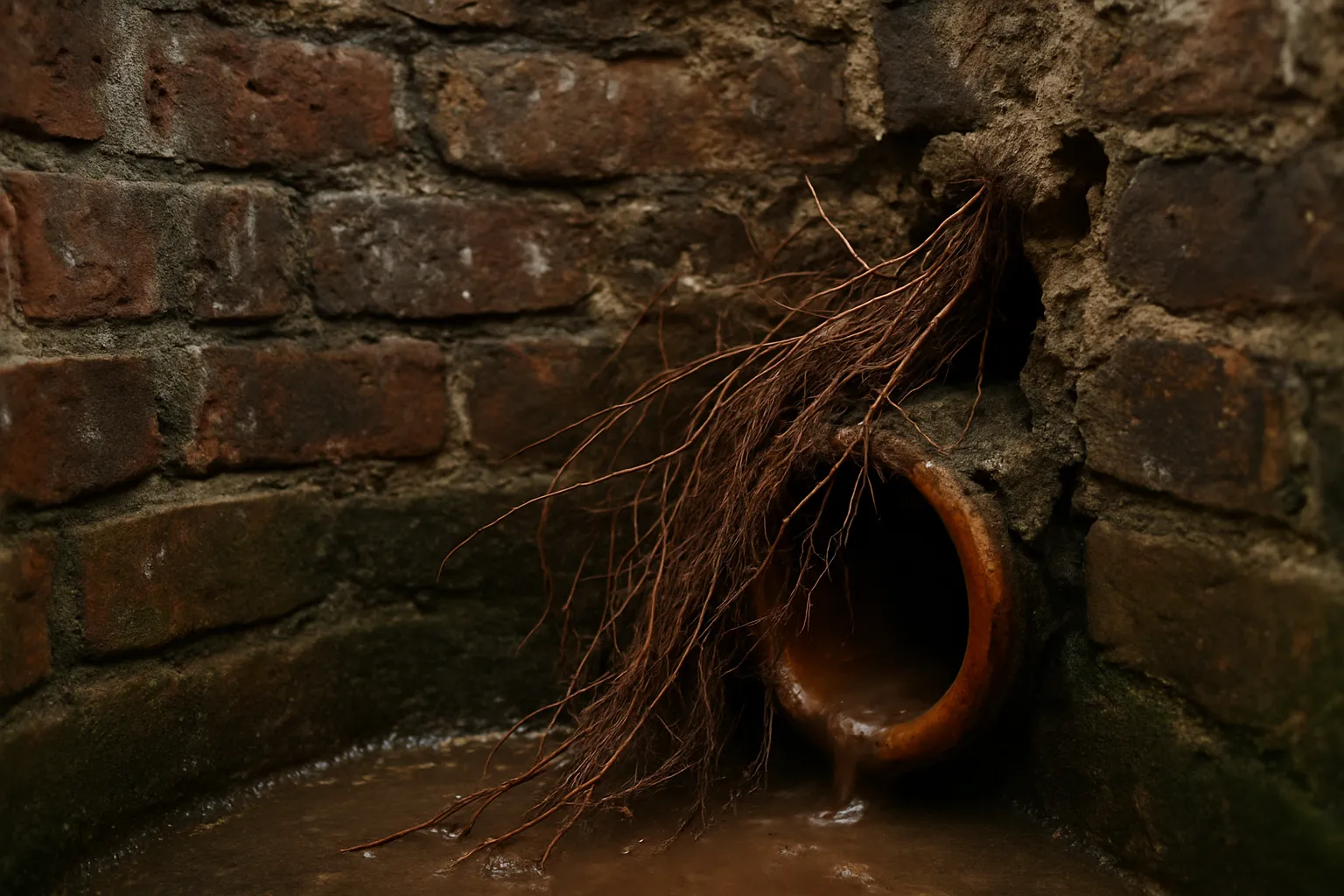
Over 100-plus years, ground movement — from tree roots, traffic vibration, frost and simple settlement — opens those joints by a few millimetres. That gap is enough for:
- Fine root tendrils to enter, grow and eventually fill the pipe completely
- Silt and debris to catch and accumulate
- Groundwater ingress, which increases flow volume and can overwhelm older combined systems
The Interceptor Trap
Many Victorian properties were built with an interceptor trap (sometimes called a disconnecting trap) at the point where the private drain meets the public sewer. The idea was to stop sewer gases travelling back into the property — a genuine public health concern at the time.
The interceptor has a deep water seal and, on one side, a small rodding arm sealed with a stopper. That stopper is notorious for two things: falling in (creating an instant blockage) and accumulating grease and debris that nothing downstream will shift without direct access.
If your property has an interceptor and you do not know where it is, a CCTV drain survey will locate it quickly.
Limited or No Rodding Access
Modern drainage layouts include rodding eyes at regular intervals — access points that let a plumber clear a blockage without excavating. Victorian systems were often laid with no intermediate access whatsoever. A single inspection chamber at the boundary was considered sufficient.
The practical consequence: when a Victorian drain blocks at the midpoint of a long run, clearing it means either:
- Threading rods from the chamber at one end (sometimes 15–20 metres away)
- Working back from the stack or gully at the other end
- Or, in stubborn cases, digging
Why Tree Roots Are a Particular Problem in Period Streets
The mature plane trees, limes and horse chestnuts that line many TW-area streets are part of what makes Richmond and Twickenham so attractive. They are also relentless drain infiltrators. Roots follow moisture, and a slightly open clay joint with warm wastewater running through it is exactly what a root system is looking for.
Once inside, roots do not simply sit there — they form a mesh that traps tissue, grease and food waste. The blockage builds gradually until one day the sink drains slowly, then stops entirely.
What a CCTV Drain Survey Actually Shows You
A camera survey is the single most useful thing you can do in a period property if you are experiencing repeated blockages or buying a house. A modern push-rod or crawler camera will show:
- Root ingress — where, how severe, and from which direction
- Displaced or cracked joints — sections that will continue to cause problems even after clearing
- The interceptor location and condition — including whether the stopper is in place
- Pipe gradient — Victorian drains were sometimes laid at the wrong fall, meaning solids settle rather than flush through
- Any collapsed sections — rare but not unknown in very old runs
The survey produces a video record and a written report. That documentation is yours to keep and is useful if you need to discuss drainage works with a builder, a local authority or your own insurer.
Practical Steps for Period Property Owners
- Know where your inspection chamber is. Lift the cover periodically and check it is not silting up.
- Avoid pouring fats and oils down the drain. Victorian pipes have rougher interiors than modern plastic, and grease clings more readily.
- Watch for slow drainage as an early warning. A partial blockage is far cheaper to clear than a full one that has been left for weeks.
- Consider a survey before buying. A specialist drainage survey is separate from a standard homebuyer’s survey and specifically examines the below-ground drainage.
When to Call Immediately
If water is backing up through a ground-floor gully, overflowing from an inspection chamber, or you can smell sewage inside the property, do not wait. A backed-up Victorian drain can overflow into subfloor voids where the damage is invisible until it is extensive.
We cover Richmond, Twickenham, Teddington and the wider TW postcode area around the clock. If your drains are causing concern right now, call us on 07360 268948 — we are available 24 hours a day, seven days a week.
Our sister drainage firm Drainiacs filmed what a CCTV camera sees down a Victorian drain in local period homes.