Emergencies
Blocked Drain Outside Your House: Whose Problem Is It and Who Pays?
Overflowing drain cover in your garden? Learn how to tell if the blockage is your responsibility or the water company's — before you pay anyone a penny.
Published 16 July 2026
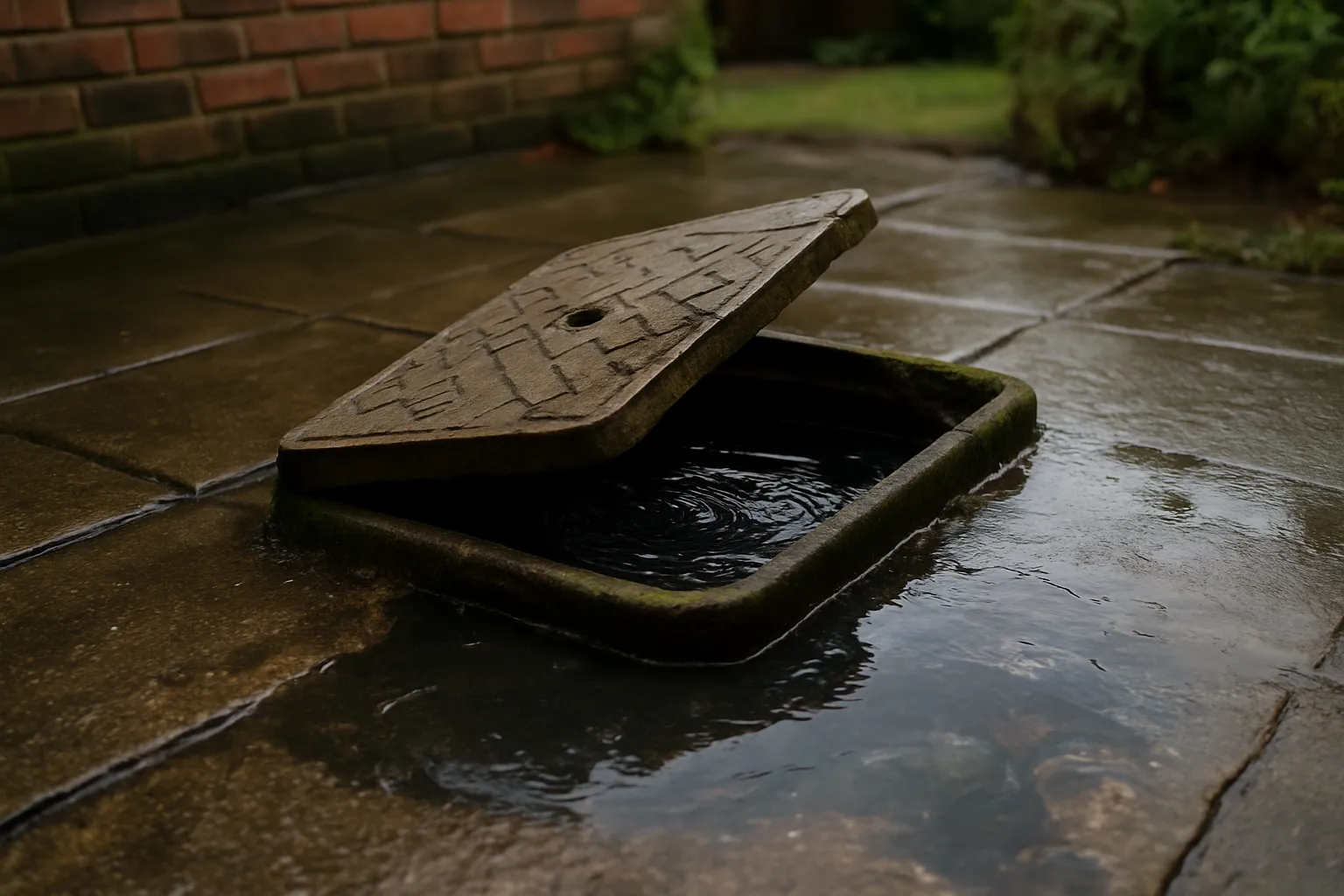
You lift the manhole cover in the garden and find it brimming with black water. Or you notice the drain cover on the driveway bubbling every time someone flushes. It is unpleasant, it can cause real damage, and the first question most people ask is: do I have to pay for this?
The answer depends on exactly where the blockage sits. Get that right before you ring anyone, and you could save yourself a significant bill.
The Basic Rule: Private Drain vs Public Sewer
In England and Wales, the law draws a fairly clear line.
Your responsibility: A drain that serves only your property — from your sinks, toilets and gullies, running beneath your land to the boundary — is a private drain. Blockages in it are yours to sort.
Thames Water’s responsibility: Once that drain connects to a shared sewer (one that collects waste from more than one property), the sewer becomes a public sewer maintained by Thames Water, which covers the TW postcode area. Blockages in the public sewer are theirs to clear, at no cost to you.
This boundary shifted in October 2011 when the Government transferred shared private sewers to the water companies. Many homeowners in Hounslow, Twickenham and Richmond are still unaware of this change and pay unnecessarily for clearances that Thames Water should handle.
How to Work Out Which Side of the Line You Are On
Step 1 — Find your manhole covers
Walk the boundary of your property. Manhole covers inside your boundary that only collect waste from your house point to a private drain. A manhole cover shared with a neighbour, or sitting on or beyond the boundary, is more likely to be on a public sewer.
Step 2 — Check whether neighbours are affected
If the drain cover on your driveway is overflowing and your neighbour’s toilet is backing up, the blockage is almost certainly in the shared sewer — Thames Water’s problem.
If the problem is isolated to your property only, it is more likely to be your private drain.
Step 3 — Use Thames Water’s sewer map
Thames Water provides a free online map of public sewers. Search “Thames Water sewer maps” and enter your postcode. If the pipe running under your garden is shown as a public sewer, any blockage in it is not your financial responsibility.
Step 4 — Look at where the water is coming from
An overflowing gully (the square drain that takes rainwater and surface water from your path or drive) is usually private. A manhole that takes foul water from multiple properties is more likely to be public. Surface-water drains and foul-water drains are separate systems in many parts of Hounslow and Feltham, so check which type is affected.
Who to Ring First
| Situation | First call |
|---|---|
| Neighbours also affected, or manhole is on/beyond boundary | Thames Water: 0800 316 9800 (free, 24/7) |
| Problem isolated to your property only | A local plumber or drainage specialist |
| Sewage backing up into the house | A plumber immediately — stop use of all toilets and taps |
| Unsure | Thames Water first — they will tell you if it is private |
Thames Water will attend a public sewer blockage free of charge, usually within a few hours for an active overflow. There is no harm in ringing them first even if you are unsure; they will redirect you if the problem turns out to be private.
If It Is Your Private Drain
A blocked external drain on your own property is still a straightforward job for a drainage engineer. Common causes in older TW-area housing include:
- Root ingress from garden trees (very common in Richmond and Twickenham)
- Fat and grease build-up in kitchen waste pipes
- Collapsed or cracked clay pipes in Victorian-era properties
- Wet wipes and sanitary products that have been flushed
A CCTV drain survey will locate the blockage and identify whether the pipe is damaged. High-pressure water jetting clears most blockages quickly. If the pipe is cracked or collapsed, a patch repair or short section replacement is usually needed.
A Note on Insurance
If sewage has entered your home or caused damage to flooring, walls or contents, check your home insurance policy. Insurers typically ask for evidence of the cause — photographs of the overflow, a written report from the engineer who attended, and details of what was found. Keep any paperwork from Thames Water if they attend, and ask your plumber or drainage engineer for a written record of their findings. That documentation belongs to you and supports any claim you choose to make with your insurer.
Practical Steps While You Wait
- Do not use toilets, sinks or washing machines if there is any risk of sewage backing up inside.
- Keep children and pets away from the overflowing drain.
- Photograph the overflow, the manhole cover location, and any affected areas inside the house.
- If sewage is reaching a watercourse, contact the Environment Agency on 0800 80 70 60.
A blocked drain outside your house is stressful, but in many cases it is not your bill to pay. Take five minutes to establish which side of the boundary the blockage falls on before calling anyone out.
If the problem is on your private drain and you need it cleared quickly — or if sewage is already backing up inside — call us any time on 07360 268948. We cover Hounslow, Feltham, Isleworth and the surrounding area around the clock.
Our sister drainage firm Drainiacs cover the same question from the engineer’s side in blocked drain outside your house: who is responsible.