Emergencies
Pinhole Leaks in Copper Plumbing: Why They Happen and What to Do
What causes pinhole leaks in copper plumbing? Learn about chloramines, aggressive water and dezincification in the TW area — and when to call a plumber.
Published 4 August 2026
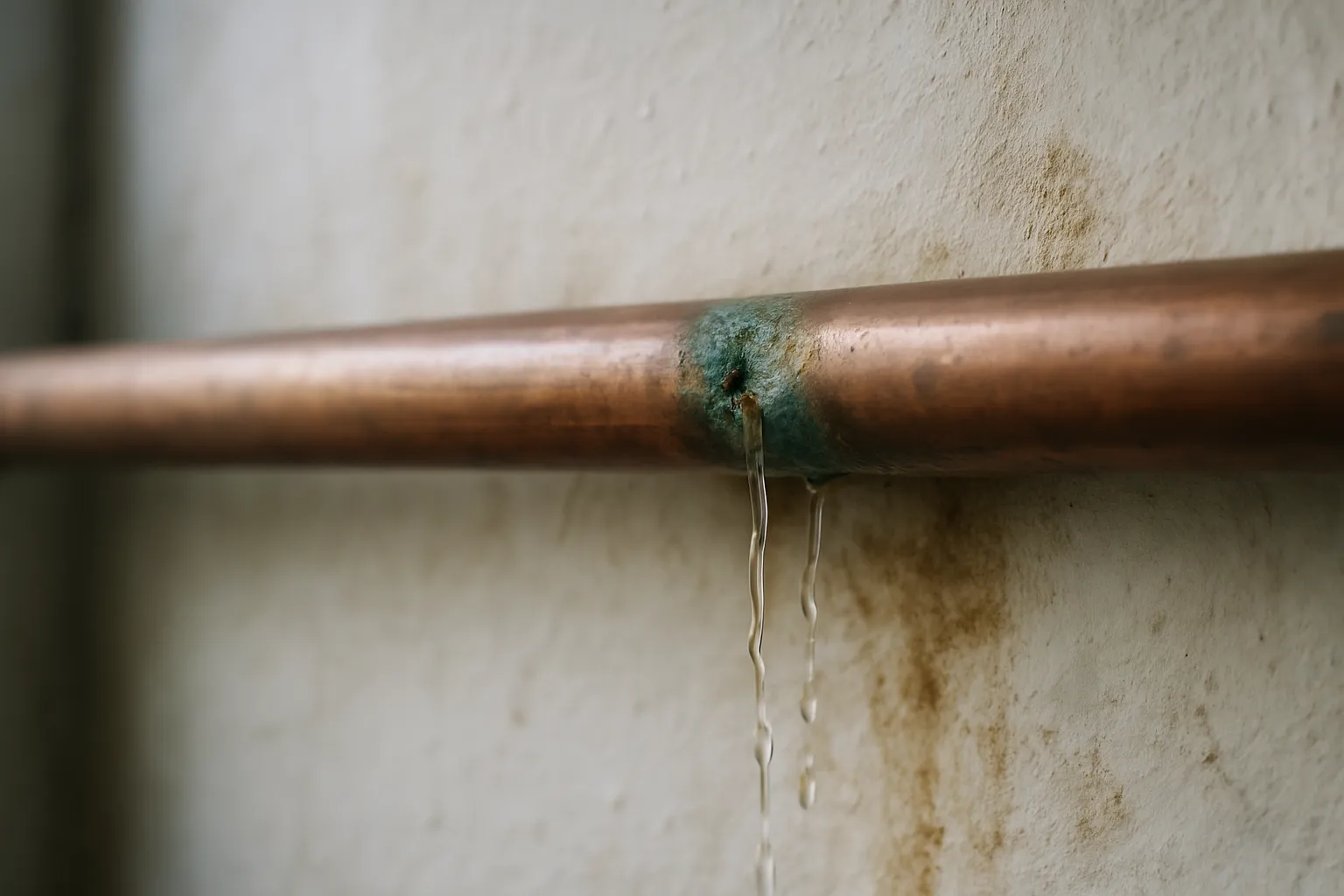
A pinhole leak sounds minor. In practice, a hole no bigger than a needle tip can drip several litres a day behind a wall or above a ceiling — long before you notice the damp patch. Understanding what causes these leaks in copper plumbing helps you catch the problem early and stop it from becoming a serious repair.
Why Copper Corrodes from the Inside
Copper has been the standard for household plumbing for decades because it is durable and naturally resistant to corrosion. That resistance is not unlimited, however. Several chemical and physical factors can eat through copper pipe walls over time, and the TW area has a few specific conditions worth knowing about.
Chloramines in the Water Supply
Thames Water treats mains water with chloramines — a combination of chlorine and ammonia — as a disinfectant. Chloramines are more stable than chlorine alone, which is good for water quality over long distribution runs. For copper pipework, though, chloramines are more aggressive than plain chlorine. At elevated concentrations they can break down the thin oxide layer that normally protects the inside of a copper pipe, leaving bare metal exposed to a slow but relentless electrochemical attack. Over years, this pits the pipe wall from the inside outward until a pinhole forms.
Aggressive (Soft) Water
Water hardness varies across the TW postcode area. Parts of Twickenham, Richmond and Teddington can receive water that is softer than average, particularly after blending at treatment works. Soft water carries fewer dissolved minerals, which sounds appealing, but those minerals — chiefly calcium carbonate — actually form a microscopic protective scale on the inside of copper pipes. Without that scale, slightly acidic water sits directly against the copper and corrodes it. The lower the pH and the softer the water, the faster pitting progresses.
Stray Electrical Currents
Copper pipes that are used as an earth path for electrical installations can suffer electrolytic corrosion. A small, continuous current accelerates ion loss from the pipe wall, producing clusters of pits that eventually breach the copper. This is more common in older properties where bonding arrangements have been modified over the years.
High Water Velocity and Turbulence
Where water moves fast — immediately downstream of a partially closed stopcock, a tight elbow, or a pump — turbulence strips away the protective oxide layer mechanically. The result is erosion-corrosion: a pattern of pits on the inside of bends and fittings rather than along straight runs.
Dezincification (in Brass Fittings)
Strictly speaking, dezincification affects brass fittings rather than copper pipe itself, but the two are closely connected. Brass is an alloy of copper and zinc. In certain water conditions, zinc leaches out of the fitting, leaving behind a porous, weakened copper structure. A dezincified fitting can fail at the joint, causing what looks like a pinhole leak at the pipe but is actually a fitting failure. Look for a chalky, reddish deposit around a joint as an early indicator.
Signs You May Have a Pinhole Leak
- A persistent damp patch on a ceiling, wall or floor with no obvious source
- A faint hissing sound inside a wall when taps are running
- Your water meter moving when all outlets are closed
- Green or blue-green staining on or around copper pipework
- Unexplained rises in your water bill
What to Do Right Now
If water is actively dripping or running:
- Turn off the water supply at the nearest isolation valve or, if necessary, at the main stopcock (usually under the kitchen sink).
- Turn on a downstream tap to relieve pressure in the pipe.
- Place a container under any drip and protect flooring with towels.
- Photograph the leak, the surrounding area, and any staining before you mop up — this evidence is useful for your own records and for any insurance purposes.
Do not use self-amalgamating tape or push-fit repair couplings as a permanent fix. They can mask a leak temporarily, but a pipe that has pitted in one place has almost certainly pitted in others nearby. The underlying corrosion needs to be assessed properly.
What a Plumber Will Do
A qualified plumber will isolate the affected section, cut out the corroded pipe and replace it with new copper or an appropriate alternative. Where chloramine attack or aggressive water is suspected, they may recommend a whole-house water filter or a pH-correction unit to slow future corrosion. If dezincification is found at fittings, all similar fittings in the system are worth inspecting at the same time.
When to Call Us
If you have an active leak, or you have found signs of a pinhole leak and are not sure how far the damage extends, call us now on 07360 268948. We cover Twickenham, Richmond, Teddington, Hounslow, Isleworth, Feltham, Staines and the surrounding TW postcode area, around the clock. We will find the source, stop the leak, and give you a clear written record of the cause and work carried out.