Emergencies
Overflowing Bath or Basin: Stop the Water and Limit Damage
Practical steps to stop an overflowing bath or basin, protect your home and prevent water reaching the ceiling below.
Published 28 June 2026
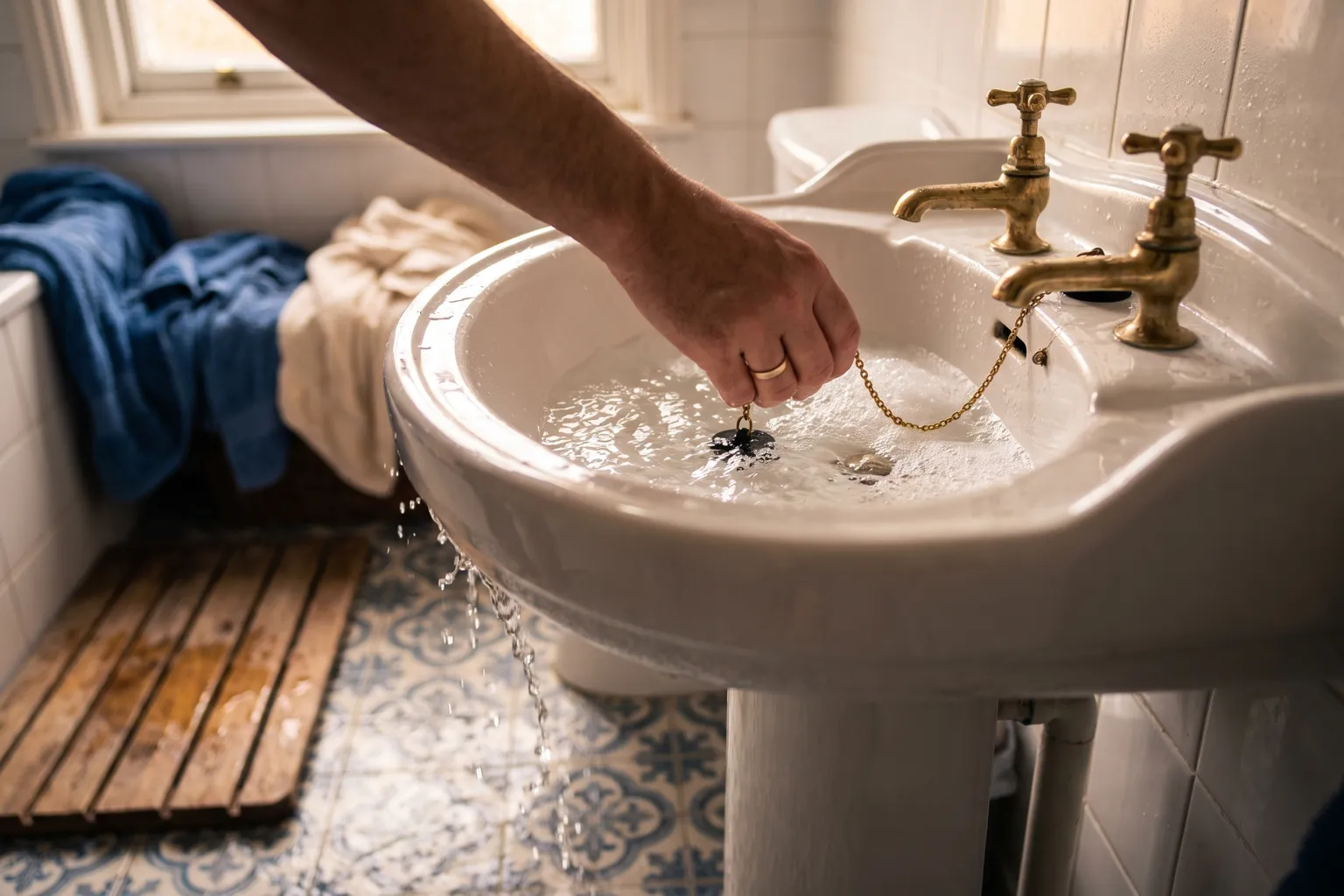
An overflowing bath or basin can go from a minor nuisance to a serious structural problem in minutes. Water finds every gap — around sealant, through floorboards, into light fittings, and down to the ceiling of the room below. Acting quickly and in the right order makes a real difference.
Here is exactly what to do.
Step 1: Pull the Plug Immediately
It sounds obvious, but in a panic people sometimes reach for towels first. The single fastest way to reduce the volume of water is to remove the plug or open the waste. Do this before anything else. Even if the overflow outlet has failed, draining what is already in the bath or basin buys you time.
If the tap is still running, turn it off at the same time or ask someone else to do it while you pull the plug.
Step 2: Lay Towels Down — but Think About Direction
Once the flow has stopped, lay towels, bath mats or any absorbent material flat across the wet floor. The goal is to slow the spread toward the door and into the hallway, where water can travel further and reach floor voids more easily.
Do not pile towels into a mound. Flat coverage over a wide area absorbs more than a thick pile in one spot.
If you have a mop and bucket, use them alongside the towels to remove standing water as quickly as possible.
Step 3: Check the Room Below Straight Away
This is the step most people delay — and it is the most important one for preventing serious damage.
Go to the room directly beneath the overflow and look at the ceiling carefully. You are looking for:
- Damp patches or discolouration — often a yellowish or grey stain appearing quickly
- Bubbling or sagging plaster — a sign that water has pooled on top of the ceiling
- Water dripping from a light fitting or ceiling rose — this is a potential electrical hazard
If the ceiling is bulging or dripping
A bulging ceiling means water has collected above it. If left, it can collapse under the weight. Use a screwdriver or similar tool to make a small hole at the lowest point of the bulge and place a bucket beneath it. This releases the water in a controlled way rather than letting the ceiling fail on its own.
If water is near any light fitting, switch off the circuit at your fuse box immediately. Do not use the light switch itself. Water and live electrical fittings are a serious risk.
Step 4: Isolate the Water Supply if the Tap Won’t Stop
If a tap has jammed open or a washer has failed and you cannot stop the flow at the tap itself, turn off the water supply to that bathroom. There is usually an isolator valve on the supply pipe under the basin or behind an access panel near the bath. Turn it clockwise until it stops.
If you cannot find an isolator valve, turn off the main stopcock. In most TW-area homes this is under the kitchen sink or in the downstairs cloakroom. Turning it off cuts the water supply to the whole property, which is the right call in a serious overflow.
Step 5: Document the Damage
Once the immediate emergency is under control, take photographs of everything — the floor, the ceiling below, any damaged plasterwork, and the source of the overflow. Your home insurer will ask for evidence, and having a clear record taken promptly is far more useful than trying to reconstruct events later.
Why Overflows Happen
Most bath and basin overflows come down to one of three causes:
- Blocked or slow-draining waste — soap scum, hair and limescale build up in the trap and waste pipe, so the basin fills faster than it drains
- Faulty overflow outlet — the small overflow hole near the top of the basin or bath is itself blocked with limescale or debris
- A tap that would not turn off — worn washers or a seized cartridge can make a tap impossible to close fully
The first two are maintenance issues that are straightforward to fix once the emergency has passed. The third may need a plumber to replace the tap internals.
When to Call a Plumber
Call us if:
- Water has reached the ceiling below and you are concerned about the extent of the damage
- A tap cannot be turned off and isolating the supply is not solving the problem
- The waste or overflow outlet is blocked and you cannot clear it yourself
- You are unsure whether the floor structure has been affected
Water damage spreads further than it looks on the surface. If there is any doubt about what is happening inside the floor or ceiling, it is worth getting a professional eye on it sooner rather than later.
We cover Twickenham, Teddington, Richmond, Hounslow, Feltham, Staines and the surrounding TW postcode area, any time of day or night. If your overflow has caused damage or you have water coming through a ceiling, call us now on 07360 268948.