Emergencies
Kitchen Sink Flooding the Cupboard — What to Do
Water pooling under your kitchen sink? Find the source, shut it off and protect your cupboard from damage. Practical steps from Emergency Plumbers TW.
Published 28 June 2026
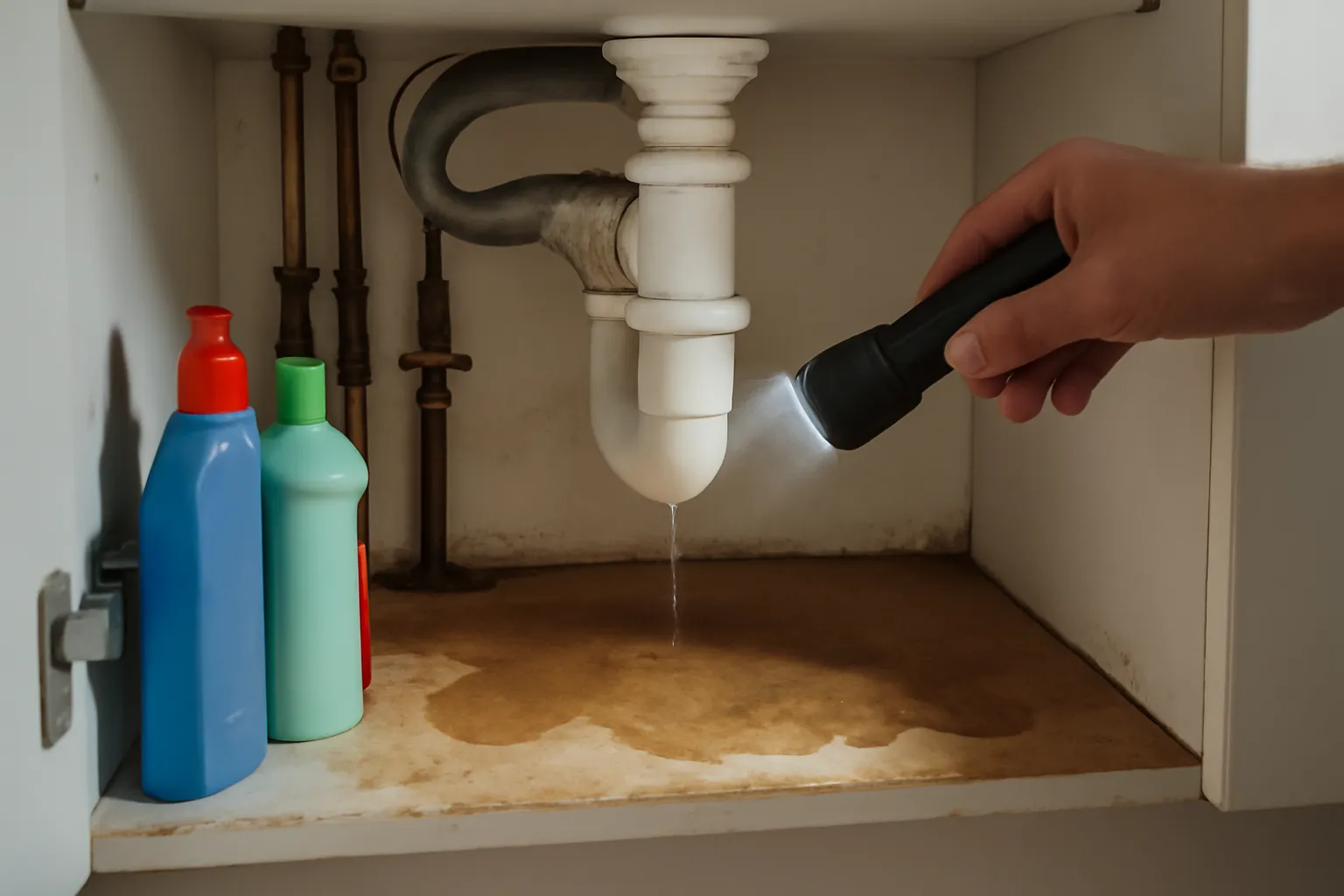
Opening the cupboard under your kitchen sink to find a puddle — or worse, a steady drip — is a sinking feeling. The good news is that most kitchen sink leaks come from a small number of places, and you can usually stop the water quickly without any tools at all. Here is what to do, step by step.
Step 1 — Stop Using the Sink Immediately
Turn off both taps and do not run the dishwasher if it drains into the same waste pipe. Every litre of water you add makes the leak worse and pushes more moisture into the cabinet base, the floor and any adjacent units.
Step 2 — Isolate the Water Supply
Look inside the cupboard for two small isolation valves — one on the hot pipe, one on the cold. They are usually chrome or white, with a flat-head screw slot. Turn each slot a quarter-turn so it sits across the pipe (perpendicular = closed). This cuts off the supply to the taps without affecting the rest of the house.
If you cannot find isolation valves, turn off your mains stopcock instead. This is typically under the kitchen sink, in a utility room, or under the stairs. Turn it clockwise until it stops.
Step 3 — Find the Source of the Leak
Once the water is off, dry the inside of the cupboard with old towels and have a good look. Kitchen sink leaks almost always come from one of three places:
The Trap (Waste Pipe)
The curved plastic pipe directly below the plughole is called the trap. It holds a small amount of water to block drain smells. The joints can work loose over time, especially after DIY work or if the trap has been knocked. Run your hand around each joint — if it is damp, that is your culprit.
The Supply Pipes (Hot and Cold)
The braided or copper pipes running from the isolation valves up to the taps can develop pinhole leaks or loose compression fittings. Dry the pipes thoroughly, then slowly open the isolation valves a fraction and watch carefully for drips.
The Sink Seal
Water can track down from the edge of the sink where it meets the worktop, particularly if the silicone sealant has cracked or shrunk. Check the rim of the sink from above — if the sealant looks grey, split or has pulled away, water from washing up can be running down the back of the cabinet.
Step 4 — Protect the Cabinet and Floor
While you wait for a plumber, remove everything from the cupboard and place it somewhere dry. Lay dry towels or old newspapers to absorb standing water. If the cabinet base is chipboard (most are), it will swell and delaminate quickly once wet — getting it dry fast is the difference between a minor repair and replacing the whole unit.
Open the cupboard doors fully to allow airflow. If you have a fan, aim it inside the cabinet. Do not use a hairdryer near any remaining water.
Step 5 — Temporary Measures (If You Need the Sink)
If you absolutely need to use the sink before a plumber arrives:
- Loose trap joint — hand-tighten the plastic collar. Do not over-tighten or you may crack it. Place a bowl underneath to catch any remaining drips.
- Loose compression fitting on supply pipe — give the nut a small quarter-turn clockwise with a spanner. No more than that.
- Cracked or perished seal — dry the area thoroughly and apply a strip of waterproof PTFE tape as a very short-term patch.
These are temporary measures only. A proper repair will still be needed.
When to Call an Emergency Plumber
Call us straight away on 07360 268948 if:
- You cannot find or operate the isolation valves or stopcock
- Water is still running despite the valves being closed
- The leak is from a copper pipe rather than a plastic joint
- There is water tracking towards a neighbouring unit, under the flooring, or near an electrical socket
- The cupboard base or flooring has already begun to swell or buckle
Leaving a slow leak unattended — even overnight — can cause significant damage to cabinetry, flooring and the structure beneath. It can also encourage mould growth within days in a confined, damp space.
We Cover the Whole TW Area, Around the Clock
Emergency Plumbers TW is available 24 hours a day, seven days a week across Twickenham, Richmond, Teddington, Hounslow, Feltham, Staines, Isleworth and all surrounding TW postcodes. If you have followed the steps above and are still concerned, or if the situation is beyond a simple fix, do not hesitate to get in touch.
Call us now: 07360 268948
We will ask you a few quick questions, give you honest advice over the phone, and get someone to you as fast as possible.