How-to
Immersion Heater Repair: When It Fails and What It Costs
Element or thermostat? Learn how to diagnose an immersion heater fault, what repair costs to expect, and when replacing the cylinder makes more sense.
Published 3 August 2026
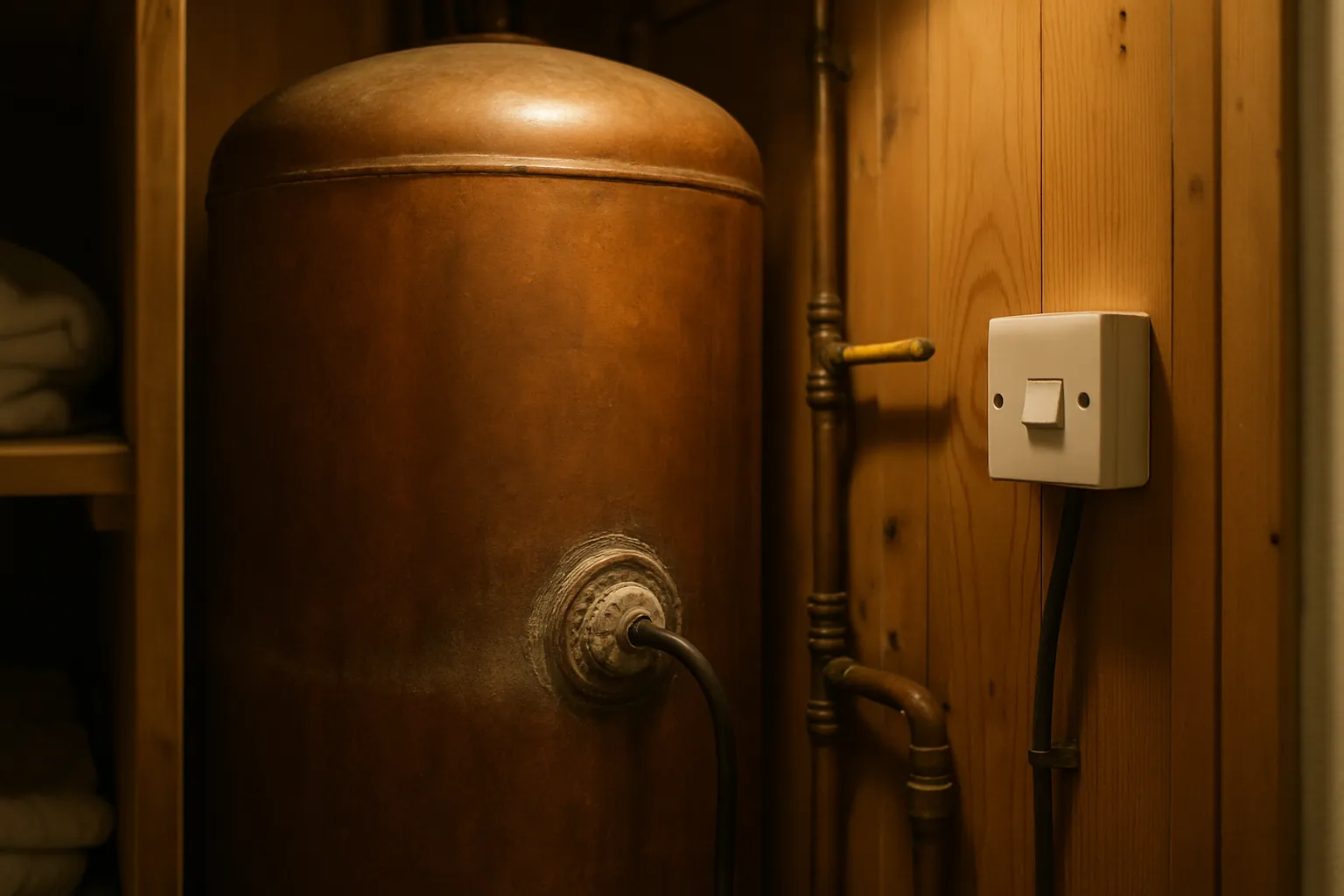
Immersion Heater Repair: What’s Gone Wrong and What Happens Next
An immersion heater is one of the simplest ways to heat domestic water — a metal element screwed into a hot water cylinder, controlled by a thermostat. When it stops working, you usually lose hot water entirely, or find the water lukewarm no matter how long you wait. The good news is that faults are generally straightforward to diagnose, and most repairs are completed in a single visit.
If you have no hot water right now, call 07360 268948 and we’ll get someone to you across the TW postcode area.
The Two Most Common Faults
1. Failed Element
The element is a metal rod — usually copper or titanium-coated — that heats the water directly. Over time it corrodes, scales up, or simply burns out. Signs of a failed element include:
- No hot water at all, even after several hours on the immersion switch
- The cylinder feels cold to the touch at the top (where a top-entry element sits)
- The RCD or fuse for the immersion circuit keeps tripping
Element replacement is the most common immersion heater repair. A plumber isolates the circuit, drains down the relevant section of the cylinder, unscrews the old element, and fits a new one. The job typically takes one to two hours depending on access and how seized the element has become.
2. Faulty Thermostat
The thermostat sits inside the element housing and tells the element when to switch off. A failed thermostat usually produces one of two symptoms:
- Water that never gets hot enough (thermostat cutting out too early)
- Water that scalds — a sign the thermostat has stuck open and the element runs continuously
Thermostat replacement is quicker and cheaper than an element swap because there is no need to drain the cylinder. The stat simply clips or screws onto the element. If your water is lukewarm rather than cold, start here.
How a Plumber Diagnoses the Fault
A competent plumber will check the element and thermostat with a multimeter before ordering parts. An element that has failed to earth or shows no continuity needs replacing. A thermostat that reads outside its rated temperature range — typically 60–82 °C — is the culprit if the element itself tests fine.
Do not attempt this yourself unless you are a qualified electrician. Immersion heaters run at mains voltage (230 V) and must be properly isolated before any work begins.
What Immersion Heater Repairs Typically Cost
Prices vary by location, time of call, and parts required. As a general guide:
| Repair | Typical scope |
|---|---|
| Thermostat replacement | Lower cost; no draining required |
| Element replacement | Higher cost; cylinder draining needed |
| Element + thermostat together | Often sensible to do both at once |
Always ask for a written quote before work begins. Emergency call-outs outside normal hours carry a higher labour rate — that is standard across the industry and worth factoring in when you decide how urgently to act.
When It Is Cheaper to Replace the Whole Cylinder
Repair is not always the right answer. Consider a full cylinder replacement if:
- The cylinder is old. Most unvented cylinders are warranted for 25 years. A copper direct cylinder over 20 years old may be approaching the end of its serviceable life.
- There is visible corrosion or pinhole leaking. A leaking cylinder cannot be patched reliably and will fail again.
- You have had repeated element failures. Frequent scaling suggests hard water attacking the element. A new cylinder with a sacrificial anode and a scale inhibitor on the supply may be a better long-term investment.
- You are switching heating systems. If you are moving from an electric immersion to a heat pump or solar thermal, a new cylinder designed for lower-temperature operation makes sense.
A plumber can give you an honest assessment once they have seen the cylinder. There is rarely any benefit in fitting a new element into a cylinder that is corroded or near the end of its life.
A Few Practical Points Before the Plumber Arrives
- Switch the immersion heater off at the fused spur if you suspect a fault. Running a failed element is wasteful and, in rare cases, a fire risk.
- Check the fused spur fuse first. A blown 13 A fuse in the spur is occasionally the entire problem.
- Note whether you have a dual-element cylinder. Some cylinders have a top element (for daily use) and a bottom element (for full-tank heating). Knowing which has failed helps the plumber bring the right parts.
- Clear access to the airing cupboard. The more space around the cylinder, the faster the job.
Still Without Hot Water?
An immersion heater fault is rarely dangerous in itself, but going without hot water is genuinely disruptive. If you are in the TW area — Twickenham, Richmond, Teddington, Hounslow, Feltham, Staines or anywhere nearby — our plumbers are available around the clock.
Call 07360 268948 any time and we will talk you through the situation before anyone sets off.