How-to
Immersion Heater Not Heating Water? Reset Button, Thermostat or Failed Element
Diagnose why your immersion heater has stopped heating water — tripped cut-out, failed thermostat or scaled element — and know when to call a plumber.
Published 22 July 2026
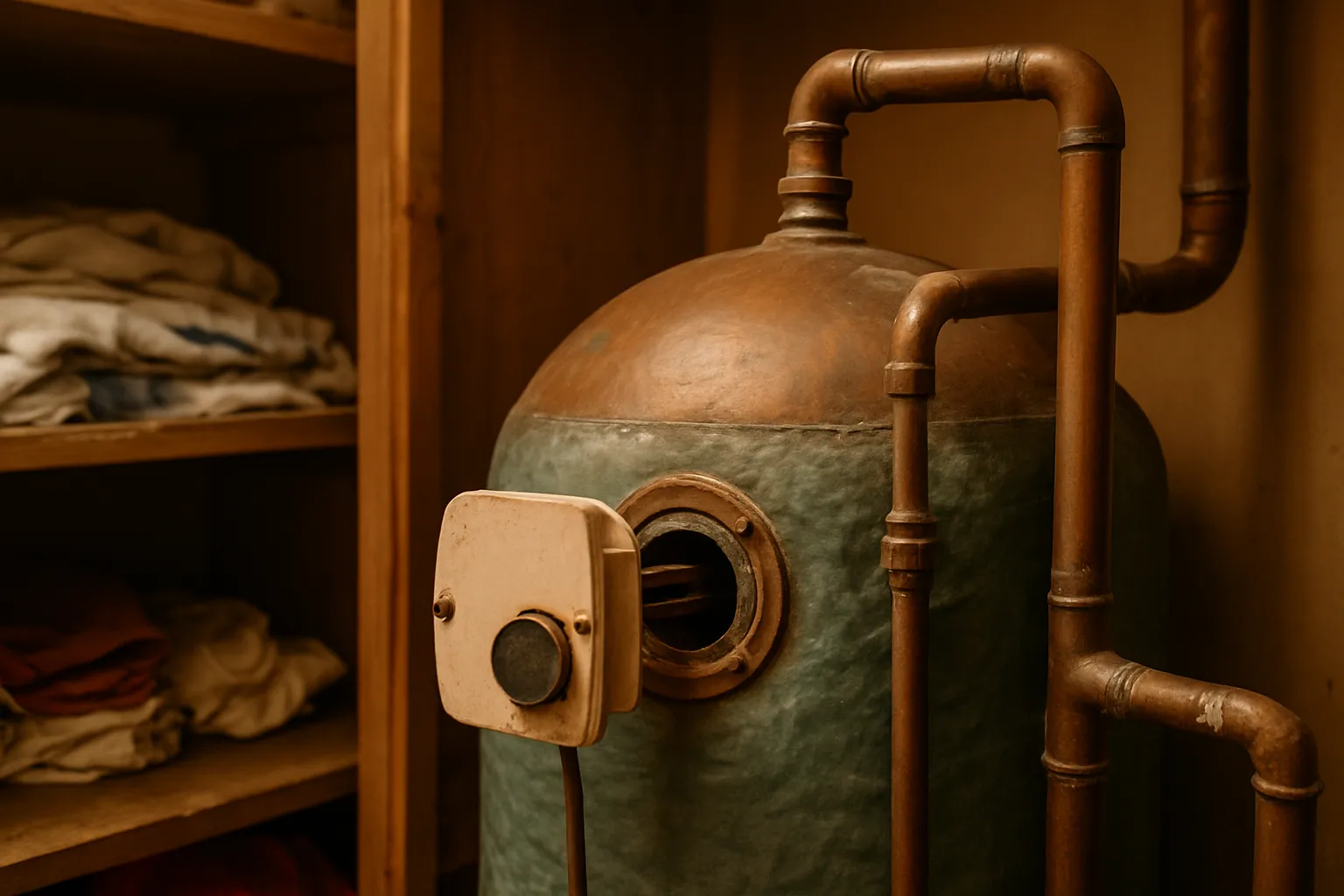
Coming home to a cold cylinder is frustrating, but the cause is usually one of four things: a tripped fused spur or circuit breaker, a thermal cut-out that has operated, a failed thermostat, or a scaled or burnt-out element. This guide walks through each in order, from the simplest fix to the one that needs a professional.
Step 1 — Check the Fused Spur and Consumer Unit
Before touching the immersion heater itself, check the electrical supply.
- Find the fused spur on the wall near the airing cupboard. It should be switched on and its indicator light (if fitted) should be lit.
- Check your consumer unit (fuse box) for a tripped breaker labelled “immersion” or “water heater”. Reset it once if it has tripped.
- If the breaker trips again immediately, stop. A breaker that won’t hold indicates a wiring or element fault — call a qualified electrician.
Step 2 — Try the Thermal Cut-Out Reset (Once Only)
Every immersion heater has a thermal cut-out (sometimes called a high-limit thermostat or overheat protector). It is a safety device that shuts the heater off if the water temperature exceeds roughly 82 °C. It is separate from the working thermostat.
How to access it:
- Switch off the fused spur.
- Remove the plastic cover on the immersion heater head — usually a large flat-head screw or two quarter-turn clips.
- You will see the thermostat dial and, next to it or beneath it, a small red or white button recessed into the body.
- Press it firmly with a thin screwdriver or pen until you feel a click.
- Replace the cover, switch the spur back on, and set the thermostat to 60–65 °C.
Allow 1–2 hours for a standard 120-litre cylinder to reheat, then check whether you have hot water.
Important: Perform this reset only once. A cut-out that trips repeatedly is telling you something is wrong — it is not a fault in itself, it is a symptom.
Step 3 — Suspect the Thermostat
If the cut-out holds but the water never reaches temperature, or the heater runs continuously without ever cutting off, the working thermostat is likely at fault.
Signs of thermostat failure:
- Water is lukewarm but never hot, even after two hours.
- The cylinder is scalding hot and the heater never switched off (turn it off at the spur immediately if this happens).
- The thermostat dial feels loose or turns without resistance.
Thermostat replacement is a straightforward job for a plumber or competent electrician. The part is inexpensive; the work typically takes under an hour on an accessible cylinder.
Step 4 — Consider a Scaled or Failed Element
In hard-water areas such as Teddington, Richmond and much of the TW postcode, limescale builds up on the element over time. Heavy scale acts as an insulator, forcing the element to work harder, shortening its life and eventually causing it to burn out.
Indicators of a failed element:
- The thermostat and cut-out both appear functional, but there is simply no heat.
- You can hear a faint hissing or crackling sound when the heater is on (scale depositing or early element failure).
- The heater is more than 8–10 years old and has never had the element replaced.
A plumber will need to drain the cylinder, remove the element using a purpose-made immersion spanner, and fit a new one — along with a fresh sealing washer. It is not a DIY job on a pressurised or unvented cylinder.
When You Need an Electrician Rather Than a Plumber
| Symptom | Who to call |
|---|---|
| Breaker trips repeatedly | Electrician |
| Burning smell from spur or wiring | Electrician — switch off first |
| Thermostat or element replacement | Plumber |
| Unvented (pressurised) cylinder fault | G3-qualified plumber |
If your cylinder has a pressure relief valve discharging hot water, or you are unsure whether your system is vented or unvented, treat it as urgent and call a plumber straight away.
A Note on Unvented Cylinders
Unvented (mains-pressure) hot water cylinders — increasingly common in newer TW-area homes — have additional safety devices including a temperature and pressure relief valve (T&P valve). Work on these cylinders must be carried out by a plumber holding a G3 Unvented Hot Water qualification. Do not attempt to replace elements or thermostats on an unvented cylinder yourself.
Summary: What to Do Right Now
- Check the fused spur and consumer unit — reset a tripped breaker once.
- Press the thermal cut-out reset button once and wait two hours.
- If still no hot water, the thermostat or element needs professional attention.
- If the breaker keeps tripping, there is a smell of burning, or a pressure relief valve is discharging — act immediately.
Most immersion heater faults are entirely fixable, and a plumber can usually diagnose and repair the problem in a single visit. If you are in the TW postcode area and need help today, call us any time on 07360 268948 — we are available around the clock.