How-to
Does Buildings Insurance Cover the Water Supply Pipe Between the Meter and Your Home?
Understand who owns the supply pipe, what buildings insurance typically covers, and what evidence your insurer will ask for after a leak.
Published 22 July 2026
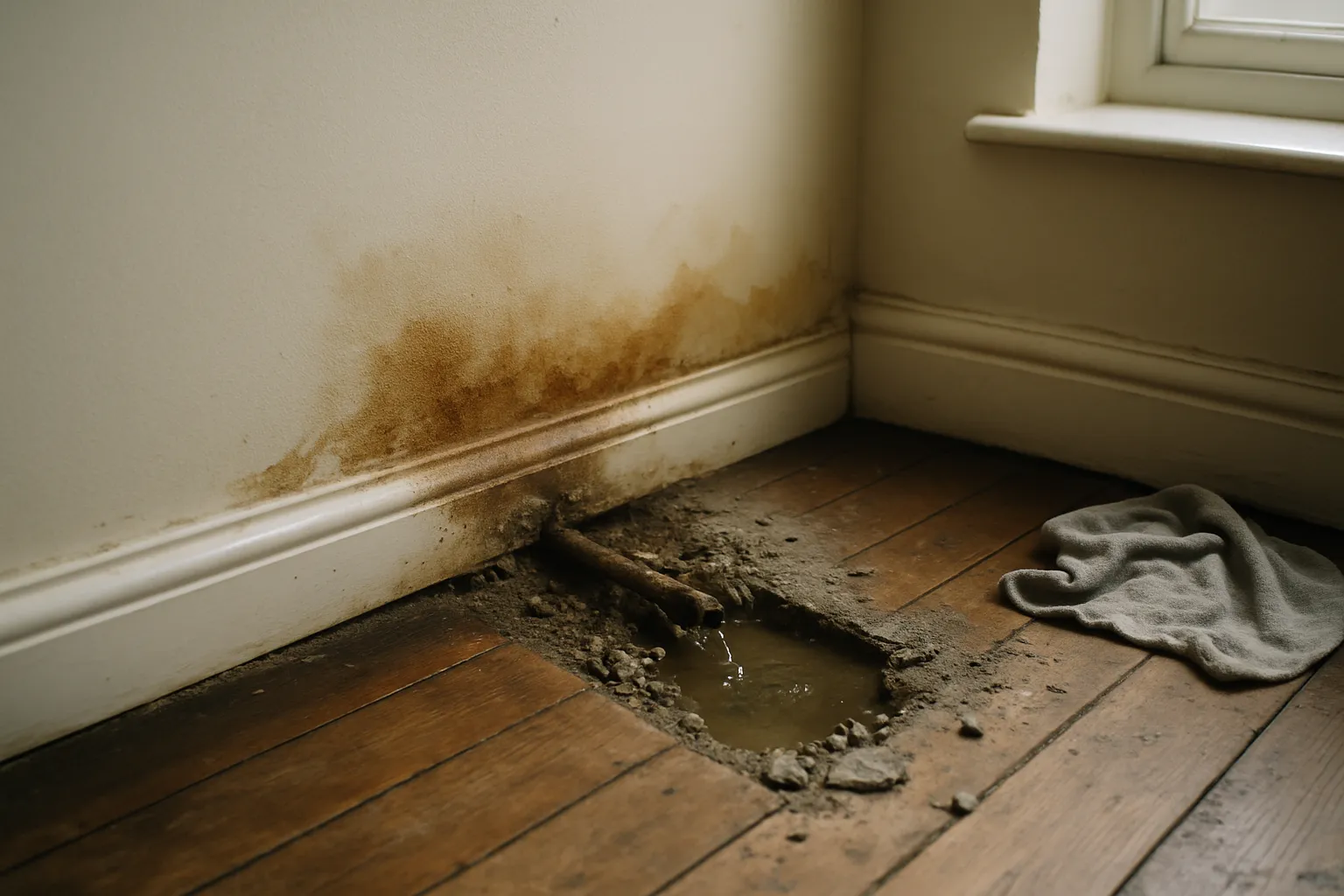
A slow rise in your water bill, a soggy patch of lawn, or a damp patch appearing on a ground-floor wall — these are often the first signs that the supply pipe running from the street to your home has developed a leak. Before you can fix the problem, you need to understand who is responsible for the pipe, and then whether your buildings insurance policy is likely to contribute to the cost of repair.
Who Owns the Supply Pipe?
The water main runs under the road and belongs to your water company (Thames Water for most of the TW postcode area). At some point — usually near the boundary of your property, often at the stop tap in the pavement — ownership and responsibility transfer to you as the homeowner.
The section of pipe that runs from that public stop tap, under your garden or driveway, and into your home is called the private supply pipe or communication pipe. It is your property, and its maintenance and repair are your responsibility. Thames Water will repair a burst on their side of the boundary at no cost to you; they will not repair anything on your side.
If you are unsure exactly where the boundary sits, Thames Water can usually tell you, and a plumber can trace the pipe with a locator tool before any digging begins.
What Buildings Insurance Typically Covers
Buildings insurance policies vary considerably, so always read your own policy documents carefully. That said, most standard policies include at least some of the following provisions relevant to supply pipes.
Accidental Damage to Underground Services
Many policies include cover for sudden and accidental damage to underground pipes, cables, and drains. A pipe that has fractured because a vehicle drove over it, or because ground movement has cracked a joint, may fall within this clause. Gradual deterioration caused by age, corrosion, or tree-root ingress is a different matter — see wear and tear below.
Escape of Water
Most buildings policies cover damage caused by an escape of water — for example, if a leaking supply pipe has saturated a floor slab or undermined a foundation. Whether the policy also covers the cost of finding and repairing the pipe itself depends on whether you have trace-and-access cover.
Trace and Access Cover
Trace and access (sometimes called “find and fix”) is a specific extension that pays for the reasonable cost of locating a hidden leak and reinstating the fabric of the building — lifting floor tiles, breaking out concrete, excavating the ground — once the leak has been found. It does not always include the cost of the pipe repair itself, so check your policy wording carefully. The limit is often between £5,000 and £10,000, though this varies by insurer and policy tier.
What Buildings Insurance Typically Does Not Cover
Wear and Tear
Gradual deterioration is almost universally excluded. If a loss adjuster determines that the pipe failed because it was old, corroded, or poorly jointed — rather than because of a sudden, identifiable event — the claim is likely to be declined or reduced. This is one reason why older lead or iron supply pipes carry more risk than modern MDPE (blue plastic) pipe.
Gradual Leaks
A leak that has been present for some time without being reported is often excluded on the grounds that it was not sudden or unforeseen. If you suspect a slow leak, act quickly: the sooner you report it and have a plumber investigate, the stronger your position.
The Pipe Itself (Sometimes)
Some policies cover only the consequential damage and not the pipe repair. Others cover both. Read the “what is not covered” section of your policy alongside the main cover section, and contact your insurer if the wording is ambiguous.
What Evidence Your Insurer Will Ask For
When you notify your insurer of a supply pipe leak, they will typically want:
- Photographs of the leak location, any excavation, and visible damage to the pipe
- A written report from a plumber stating the cause of the failure, the location of the pipe, and the scope of work required
- Moisture readings if there is any internal water damage
- Evidence of when the problem was first noticed — water bills showing unexplained usage can help establish a timeline
- Quotes or invoices for the repair work
A plumber attending an emergency will note the cause and condition of the pipe. Ask for a written report and keep all documentation — it belongs to you and you will need it when you speak to your insurer or loss adjuster.
Practical Steps If You Suspect a Supply Pipe Leak
- Turn off the internal stop tap to stop water entering the property.
- Check whether the leak is on your side of the boundary stop tap.
- Call a plumber to locate and assess the leak as quickly as possible.
- Photograph everything before, during, and after any excavation.
- Notify your insurer promptly — most policies require you to report within a reasonable time.
- Keep all invoices, reports, and correspondence.
Supply pipe leaks can be disruptive and costly, but acting quickly limits both the damage and the disruption to your claim. If you have a leak — or you are not sure whether you have one — call us any time on 07360 268948. We cover Teddington, Twickenham, Richmond, and the surrounding area, 24 hours a day, seven days a week. We will locate the fault, carry out the repair, and give you a full written record of the work.