Maintenance
Hard Water and Limescale: Protecting Your Boiler and Pipes
The TW area has hard water. Learn how limescale damages boilers and pipes, and what you can do to protect your plumbing system.
Published 30 June 2026
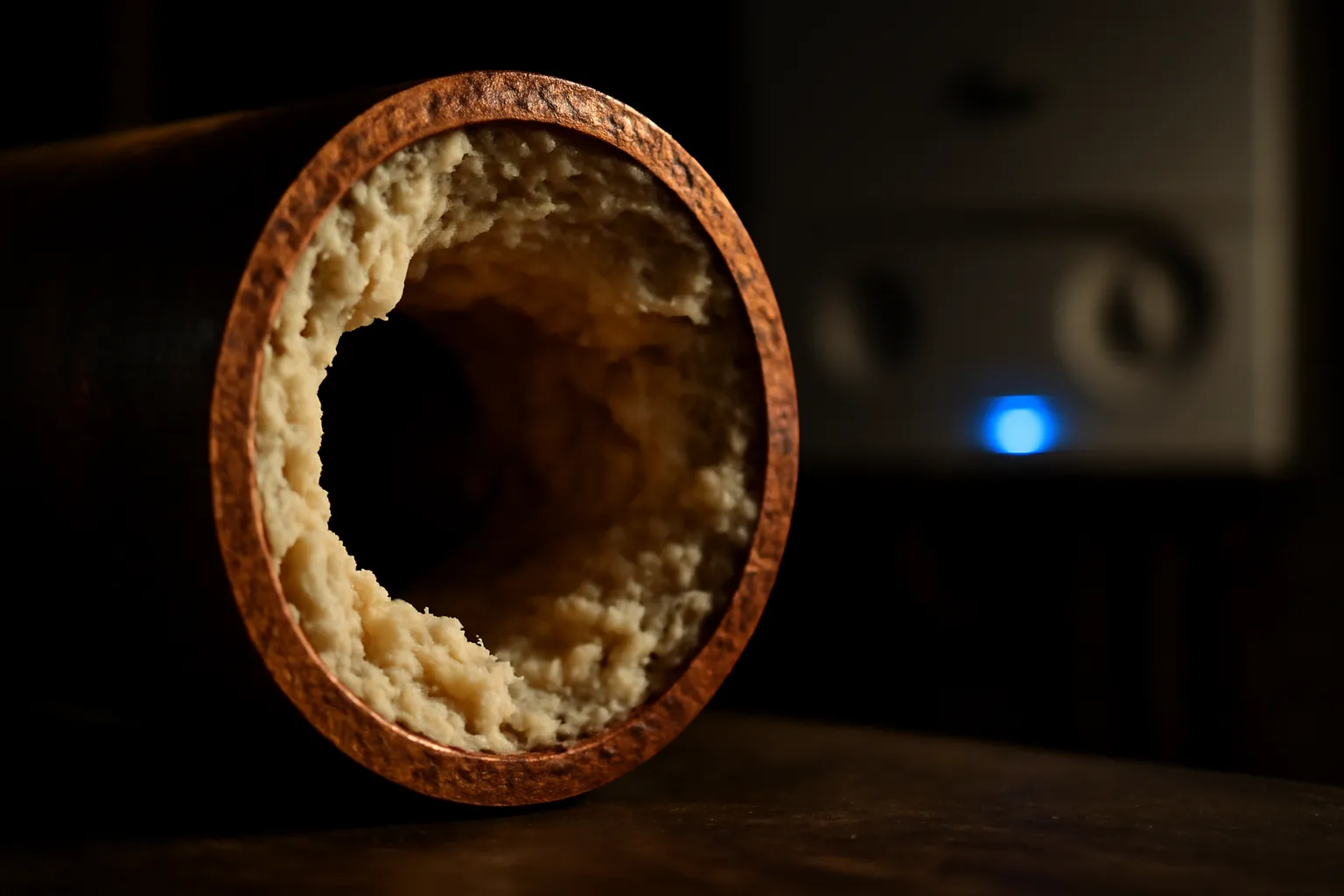
Hard Water and Limescale: What Every TW Homeowner Should Know
If you live in Twickenham, Richmond, Hounslow, Staines or anywhere else in the TW postcode area, your water supply is classified as hard or very hard. That is not a quality problem — the water is perfectly safe to drink — but it does mean your plumbing system is quietly accumulating limescale every single day.
Left unchecked, that build-up can shorten the life of your boiler, reduce water pressure, and eventually cause leaks or blockages that need an emergency plumber. Understanding what is happening inside your pipes is the first step to preventing an expensive call-out.
What Is Hard Water, and Why Does the TW Area Have It?
Hard water contains dissolved minerals — mainly calcium and magnesium — picked up as rainwater filters through chalk and limestone geology. Thames Water consistently records high hardness levels across the TW area, typically above 300 mg/litre (expressed as calcium carbonate). That puts it firmly in the “very hard” category by UK standards.
When hard water is heated, the dissolved calcium carbonate becomes insoluble and deposits itself on whatever surface it touches: the inside of your boiler heat exchanger, your hot water cylinder, your pipes, and your taps.
How Limescale Damages Your Boiler
Your boiler is the most vulnerable appliance in the system, because it heats water repeatedly to high temperatures.
Reduced efficiency
Even a thin layer of scale on the heat exchanger acts as an insulator. The boiler has to work harder and burn more fuel to reach the same water temperature. A 1 mm coating can reduce efficiency by around 7–10%, which shows up directly on your energy bills.
Overheating and kettling
When scale builds up inside the heat exchanger, water flow is restricted. You may hear a rumbling or banging noise — often described as “kettling” — as water overheats and partially vaporises before it can circulate. This puts significant stress on the boiler’s components.
Premature failure
Persistent overheating accelerates wear on seals, valves, and the heat exchanger itself. Boilers in hard-water areas that receive no treatment typically fail sooner than their expected service life.
How Limescale Affects Your Pipes and Taps
- Reduced water pressure — scale gradually narrows the internal bore of hot water pipes, restricting flow over time.
- Blocked shower heads and aerators — these are usually the first visible sign of a hard-water problem.
- Dripping taps — mineral deposits can prevent tap washers and ceramic cartridges from seating properly, causing drips that worsen steadily.
- Immersion heater failure — the element in a hot water cylinder is particularly prone to heavy scaling, which causes it to burn out prematurely.
Practical Steps to Protect Your Plumbing
1. Have a scale inhibitor fitted
A magnetic or electrolytic scale inhibitor is fitted to the incoming mains supply. It does not remove minerals from the water but alters their structure so they are less likely to deposit on surfaces. It is a relatively low-cost, low-maintenance option and a sensible starting point for most homes.
2. Consider a whole-house water softener
A salt-based water softener replaces calcium and magnesium ions with sodium ions, producing genuinely soft water throughout the house. Scale stops forming almost immediately, and existing light deposits gradually dissolve. Installation requires a small amount of space (usually under the kitchen sink or in a utility area) and regular topping up with salt tablets. Running costs are modest. Many homeowners in the TW area find the investment worthwhile, particularly if they have already had one boiler fail early.
3. Use a boiler inhibitor in the central heating circuit
This is a chemical additive — separate from a scale inhibitor — that goes into the sealed central heating system itself. It prevents both scale and corrosion forming inside the radiators and pipework. Your heating engineer should check and top up the inhibitor concentration at every annual service.
4. Descale appliances regularly
Kettles, shower heads, and tap aerators can be descaled with a proprietary descaler or a solution of white vinegar and water. It is worth doing this every few months in a hard-water area rather than waiting until flow is noticeably restricted.
5. Book an annual boiler service
A qualified engineer will check for early signs of scaling and inefficiency, top up inhibitor levels, and catch minor issues before they become major ones. In a hard-water area, this annual check is particularly important.
When to Call a Plumber
Some limescale problems go beyond DIY remedies:
- Your boiler is kettling loudly or losing pressure repeatedly
- You have noticed a significant drop in hot water pressure throughout the house
- A tap or valve is leaking and will not stop despite replacing the washer
- Your boiler has developed a leak around the heat exchanger or connections
These are signs that scale may already have caused damage that needs professional attention.
Living with hard water in the TW area is unavoidable, but the damage it causes is largely preventable with the right measures in place. If you are already experiencing a boiler leak, loss of pressure, or any plumbing problem you cannot resolve yourself, we are available around the clock.
Call Emergency Plumbers TW any time on 07360 268948. We cover the full TW postcode area, 24 hours a day, seven days a week.