Emergencies
Boiler Leaking Water from the Pipe Underneath: What It Means
Water dripping from the pipe under your boiler? Learn what each pipe does, why it leaks, and what to do right now. Emergency help: 07360 268948.
Published 28 July 2026
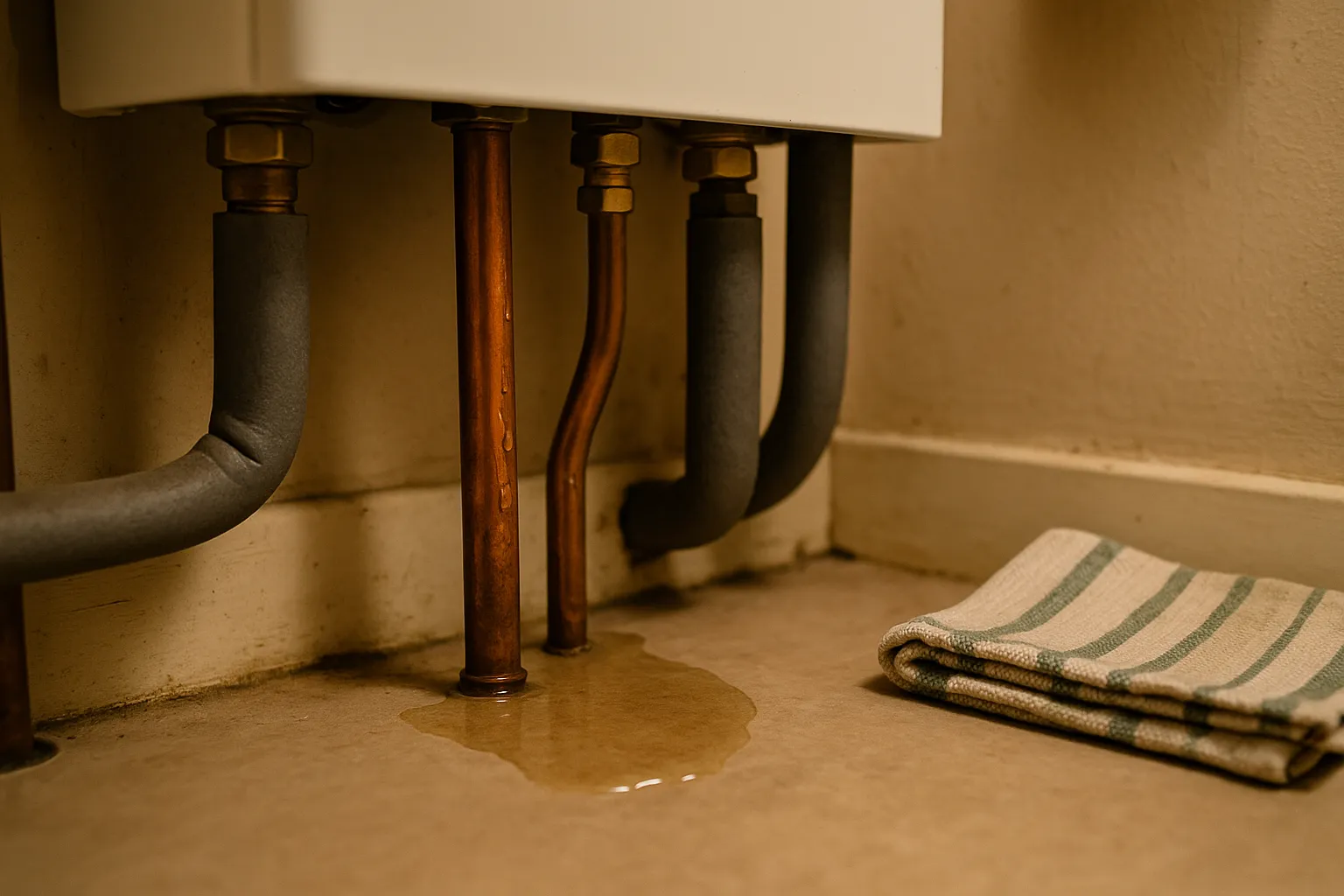
A puddle forming beneath your boiler is always worth taking seriously. The good news is that the pipe causing the problem usually tells you exactly what is wrong — and knowing which one it is helps you decide how urgently you need a plumber.
This guide walks through the three pipes most commonly found underneath or at the base of a boiler, what each one does, and why it might be leaking.
The Three Pipes Most Likely to Be the Culprit
1. The Condensate Pipe
What it is: Modern condensing boilers produce acidic condensate water as a by-product of combustion. A white or grey plastic pipe (usually 22 mm or 32 mm) carries this waste water away to a drain — often running down an external wall or through a cabinet to an internal soil pipe.
Why it leaks: The condensate pipe is plastic and push-fitted, so joints can work loose over time. If the leak is at a joint rather than a crack, it may be a straightforward fix. A cracked pipe — often caused by freezing in winter — needs replacing.
Risk level: Low immediate risk to the boiler itself, but the acidic water can damage flooring and joinery if left. The boiler may also lock out and stop working.
What to do: Place a towel or container under the drip, then call a plumber. This is not a gas-related fault.
2. The Pressure Relief Valve (PRV) Discharge Pipe
What it is: Every sealed central heating system has a pressure relief valve — a safety device that opens automatically if the system pressure climbs too high. The discharge pipe runs from the PRV (usually a small brass valve on the boiler body or pipework) to a tundish or directly outside.
Why it leaks: If you see water dripping or trickling steadily from this pipe, the PRV is discharging. This means the system pressure is too high, the valve itself has failed and is weeping, or — less commonly — the expansion vessel has lost its charge.
Risk level: Moderate to high. A PRV that keeps discharging means something in the system is wrong, not just the valve. Ignoring it can lead to the PRV failing open entirely, causing a significant leak, or — in rare cases — damage to the boiler heat exchanger.
What to do: Check your boiler pressure gauge. If it reads above 2.5 bar (especially when the system is cold), do not re-pressurise the boiler. Turn the boiler off and call a Gas Safe registered engineer. Do not attempt to cap or block the PRV discharge pipe.
3. Flow and Return Pipes
What they are: The flow pipe carries hot water from the boiler to your radiators and hot water cylinder; the return pipe brings cooler water back. These are typically 22 mm copper pipes connected to the boiler via compression or push-fit fittings.
Why they leak: Compression fittings can work loose or corrode over years of thermal cycling (expanding and contracting with heat). Solder joints can develop pinhole leaks. Flexible connectors — sometimes used where pipes meet the boiler — can crack and weep.
Risk level: Moderate. A slow drip from a compression fitting can often be caught early; a failed flexible connector can produce a faster flow. Either will cause water damage if left unattended.
What to do: Turn off the boiler. If the leak is significant, locate your central heating system isolator valves (usually on the flow and return pipes near the boiler) and close them. Call a plumber.
How to Identify Which Pipe Is Leaking
Work through this quickly:
- Is the pipe plastic? It is almost certainly the condensate pipe.
- Is water dripping from a small brass valve or a pipe that exits through the wall to outside? That is the PRV discharge pipe.
- Is the leak at a joint on a copper pipe? That points to the flow or return pipework.
If you genuinely cannot tell, or if the water is coming from inside the boiler casing itself, do not remove the casing. Call a Gas Safe registered engineer — internal boiler leaks can involve the heat exchanger, which requires specialist diagnosis.
Steps to Take Right Now
- Protect the area. Lay towels and place a container under the drip to limit water damage.
- Take photographs. Document the leak location, the pipe involved, and any water damage. This written and photographic record is yours to keep and belongs with your home insurance paperwork should you need it.
- Turn off the boiler at the programmer or thermostat if the leak is anything other than a minor condensate drip.
- Close isolation valves on the flow and return pipes if the leak is significant and you can identify them clearly.
- Call a qualified plumber or Gas Safe engineer.
When to Call Immediately
Call 07360 268948 straight away if:
- Water is dripping onto electrical components or your consumer unit
- The leak is fast or getting worse
- You smell gas at any point (in which case, also call the National Gas Emergency Service on 0800 111 999)
- The PRV is discharging and your boiler pressure is high
- You cannot identify the source of the leak
A boiler pipe leak is rarely a crisis if you act promptly. Turn off the boiler, limit the spread of water, and get a qualified engineer out to diagnose it properly. We cover the TW postcode area around the clock — call 07360 268948 any time of day or night.