Emergencies
Boiler Dripping Water Slowly: Ignore It or Fix It?
Slow drip from your boiler? Learn whether it's a PRV release, a real leak or condensation — and when to shut off versus waiting one more day.
Published 29 July 2026
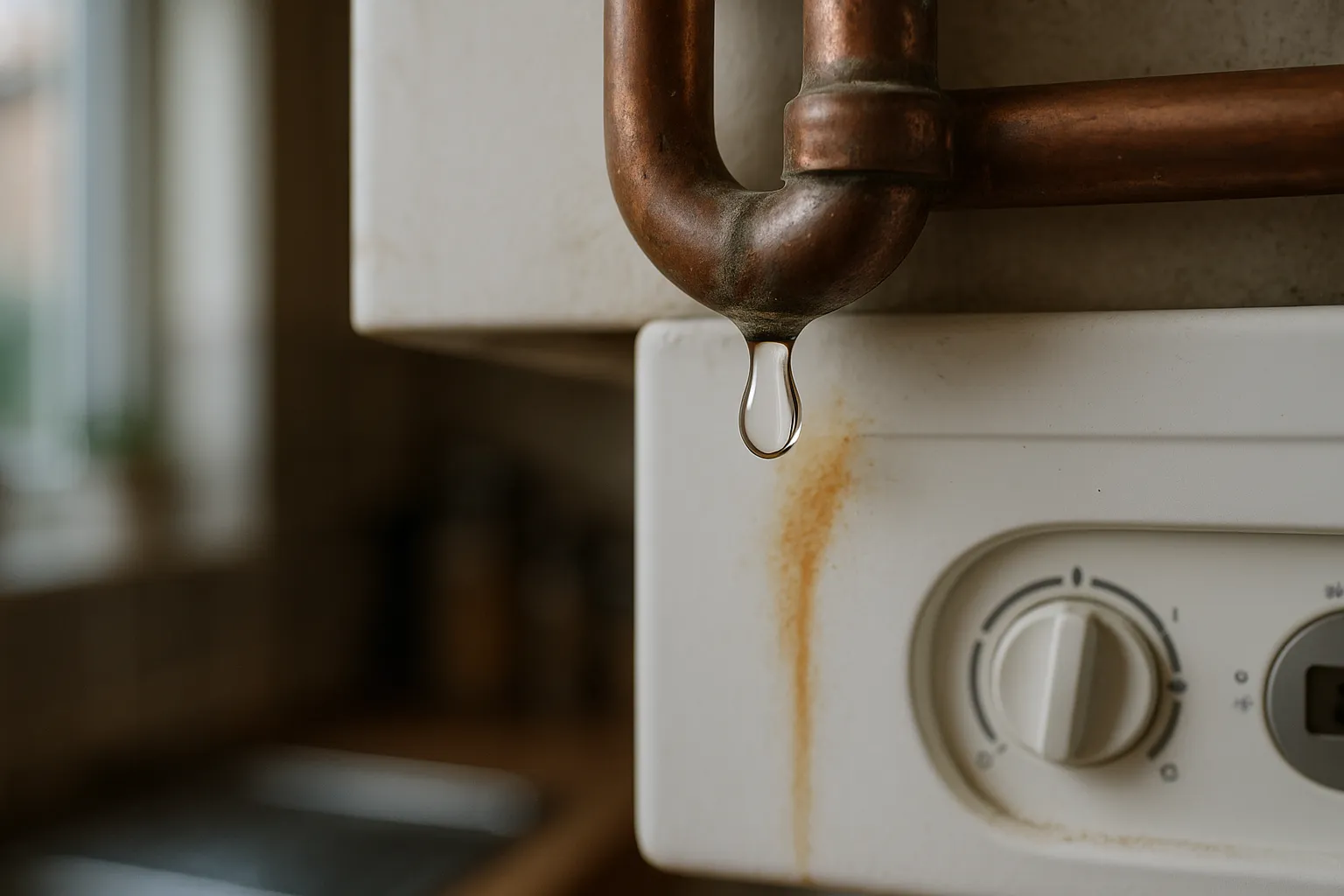
A slow drip from a boiler is easy to ignore. It is small, it is not flooding the kitchen, and the heating is still working. But a drip that carries on for days can corrode pipework, soak insulation, damage ceilings below, and occasionally signal a fault that will turn into a much bigger problem. This guide helps you work out what you are actually looking at and what to do next.
Three Things a Drip Could Mean
1. The pressure-relief valve (PRV) is releasing
The PRV is a safety device, usually a small brass valve with a plastic discharge pipe running to an outside wall or a drain. Its job is to release water when boiler pressure climbs too high. If the system pressure gauge reads above 3 bar, the PRV may be doing exactly what it should.
What to check: Look at the pressure gauge on the boiler front. Normal operating pressure is roughly 1–1.5 bar when cold. If it is consistently creeping above 2.5–3 bar, the expansion vessel may have lost its charge — a common, fixable fault — or the filling loop has been left open by mistake.
A PRV that releases occasionally is doing its job. A PRV that drips continuously has either a failed seat (it needs replacing) or it is masking a persistent over-pressure problem. Either way, it should not be left indefinitely.
2. There is a genuine water leak
Leaks from boilers most often come from:
- Pump seals — the circulating pump has a seal that wears over time; water weeps from the pump body or its connections
- Heat exchanger — hairline cracks, usually from limescale stress or freeze damage; these tend to worsen gradually
- Pipe joints and compression fittings — vibration loosens them slowly; the drip appears at a fitting rather than the boiler casing itself
- Diverter valve — on combination boilers, a worn diverter valve can allow water to track back and drip internally
If the water is coming from inside the casing or from a joint on the flow or return pipes, this is a real leak. It will not resolve on its own.
3. It is condensation
Modern condensing boilers produce a small amount of condensate as a by-product of combustion. This drains away through a white plastic pipe (the condensate pipe) to an outside drain or internal soil stack. If you see water near that pipe — especially in cold weather when the pipe can partially block — it may simply be condensate overflow.
Condensation can also form on the outside of cold-water pipes near the boiler in warm, humid conditions. Run your finger along the pipe: if the surface is simply damp and cold to the touch, that is condensation rather than a leak.
When to Shut the Boiler Off Immediately
Switch the boiler off and call a Gas Safe registered engineer or emergency plumber straight away if:
- Water is dripping onto electrical components or the boiler’s printed circuit board
- The drip has become a steady stream or is pooling on the floor
- You can smell gas at the same time
- The pressure gauge reads above 3 bar and the PRV is running continuously
- The boiler is making banging or gurgling noises alongside the drip
Do not attempt to open the boiler casing yourself. Boilers contain live electrical components and, on gas models, combustion parts that must only be accessed by a Gas Safe registered engineer.
When You Can Safely Wait One More Day
A very minor drip — a few drops per hour from a joint or a slightly weeping pump seal — is unlikely to become dangerous overnight, provided:
- The boiler pressure is in the normal range (1–1.5 bar cold)
- The water is not near any electrics
- You place a dry towel or shallow tray underneath and check it every few hours
- You book a repair for the next available appointment
Even in this scenario, “one more day” should not become one more week. Slow leaks corrode quickly, and a pump seal that weeps today can fail entirely within days.
What to Do Right Now
- Locate the drip. Is it from the discharge pipe (PRV), from a joint, from the pump, or from inside the casing?
- Check the pressure gauge. High pressure points toward the expansion vessel or filling loop; normal pressure points toward a seal or joint.
- Take a photograph and note where the water is coming from. This is useful for any insurance paperwork your insurer may ask for later.
- Place a towel or tray to catch water and protect flooring or ceilings below.
- Call a professional — even if it seems minor, a boiler leak is not a DIY repair.
If you are in the TW postcode area and your boiler is dripping water right now, call Emergency Plumbers TW on 07360 268948. We are available 24 hours a day, seven days a week, and can help you work out whether this needs urgent attention tonight or can wait until morning.