Emergencies
Water Dripping From an Overflow Pipe Outside? How to Identify the Source
Overflow pipe leaking outside your home? Learn how to identify whether it's your toilet cistern, loft tank or boiler PRV — and what to do next.
Published 22 July 2026
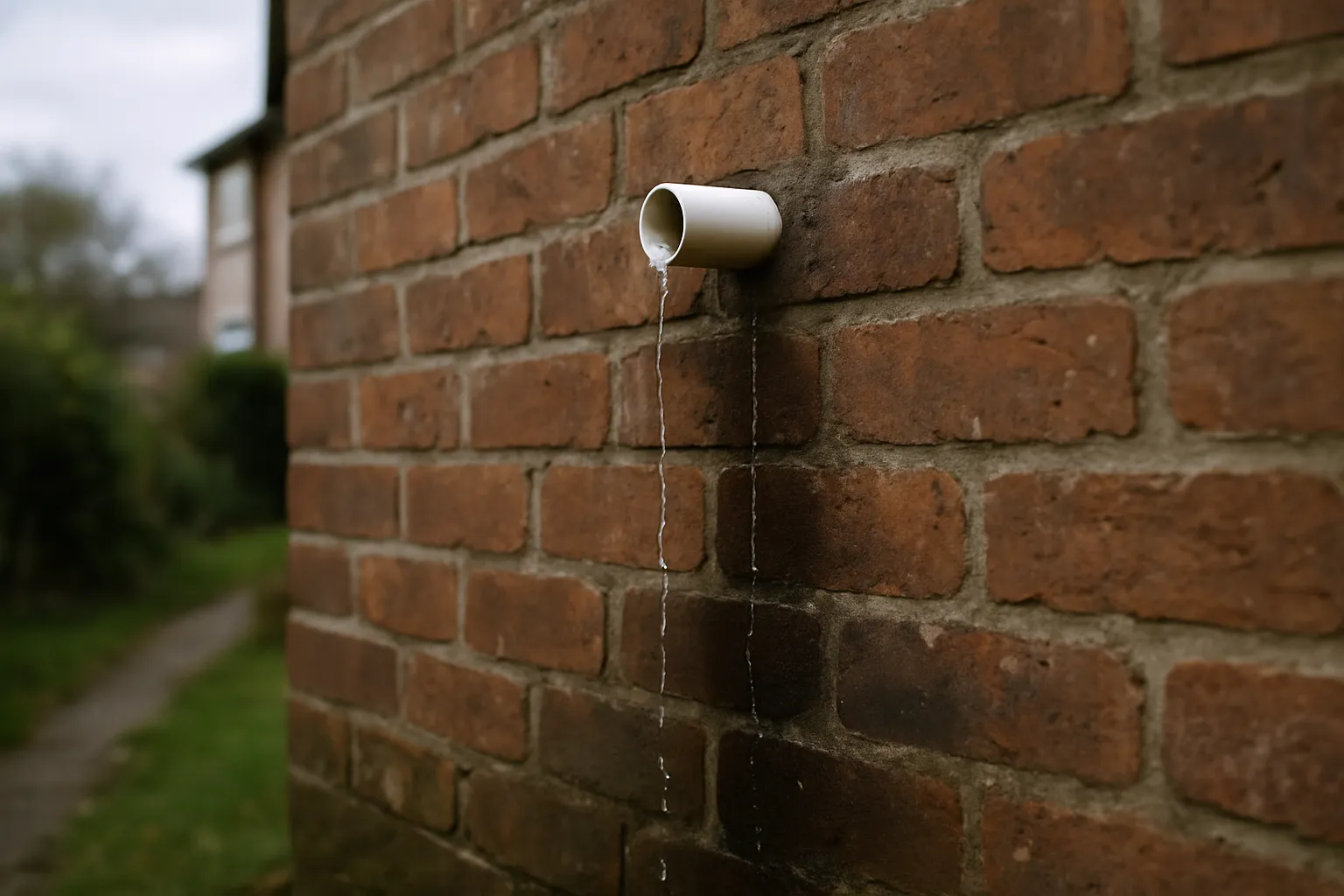
Water Dripping From an Overflow Pipe Outside Your House
A steady drip — or a constant trickle — from a pipe on your outside wall is easy to ignore, especially in wet weather. But an overflow pipe leaking is always telling you something is wrong inside. Left unattended, it can waste hundreds of litres of water a day, cause damp, and in some cases signal a pressure fault that needs urgent attention.
This guide helps you work out which system is responsible, so you can either fix it yourself or know exactly what to tell a plumber.
Step One: Look at Where the Pipe Exits the Wall
The height and position of the pipe gives you the first clue.
- High up, near the eaves or roof line — almost certainly the cold-water storage tank in your loft.
- Mid-wall, near a bathroom or toilet — likely the toilet cistern overflow.
- Low down, near a boiler flue or utility area — this is probably the boiler’s pressure-relief valve (PRV) discharge pipe.
The material matters too. Older overflow pipes are often white or grey plastic (MDPE or uPVC). A copper pipe exiting low on the wall near a boiler is a strong indicator of a PRV discharge.
The Three Most Common Sources
1. Toilet Cistern Overflow
This is the most frequent cause. Inside the cistern, the float valve (ballcock) controls the water level. If the valve wears out or the float develops a crack and fills with water, it can no longer shut off the supply. Water rises above the overflow outlet and runs outside.
What you can do safely:
- Lift the cistern lid and check the water level. It should sit roughly 25 mm below the overflow outlet.
- If the float is submerged or the arm is bent downward, try gently bending the arm upward to lower the cut-off point temporarily.
- Turn off the isolation valve on the supply pipe to the cistern (a flat-head screw slot on the pipe under the toilet) if the drip is heavy.
A new float valve is an inexpensive repair — a plumber can usually replace it in under an hour.
2. Cold-Water Storage Tank in the Loft
If you have a traditional gravity-fed system, there will be a large plastic tank in your loft. It has its own float valve, and the same failure modes apply. However, a loft tank overflow that runs continuously is more serious because:
- Large volumes of water are involved.
- If the overflow pipe itself is blocked or absent, the tank can overflow directly into the ceiling below.
What you can do safely:
- Check the loft if it is safe to do so. Look for a high water level or a float valve that is clearly not closing.
- The mains supply to the tank usually has an isolation valve nearby — turning this off will stop the fill until the valve is repaired.
- Do not ignore a loft tank overflow. Call a plumber promptly.
3. Boiler Pressure-Relief Valve (PRV) Discharge Pipe
This is the one that should not wait. A copper overflow pipe dripping near your boiler means the PRV has opened to release excess pressure from the heating system. This happens for two main reasons:
- System pressure is too high. Check your boiler’s pressure gauge. Normal cold pressure is typically 1–1.5 bar. Above 3 bar is a concern.
- The expansion vessel has failed. The expansion vessel absorbs the increase in water volume as your system heats up. If the vessel’s internal membrane has failed, pressure spikes every time the boiler fires and the PRV opens to compensate.
What you must not do:
- Do not keep topping up the system pressure if the PRV is already discharging. Adding more water raises the pressure further.
- Do not ignore it. A PRV that discharges repeatedly can eventually fail to reseat, leaving you with a continuous leak and a boiler that may lock out.
This is a job for a Gas Safe registered engineer. Diagnosing and re-pressurising an expansion vessel, or replacing a PRV, involves working on a sealed heating system and — depending on the boiler — in proximity to the gas components. Do not attempt it yourself.
Quick Identification Summary
| Pipe position | Likely source | DIY safe? |
|---|---|---|
| High on wall, near eaves | Loft cold-water tank | Isolation only |
| Mid-wall, near bathroom | Toilet cistern | Yes — float valve |
| Low wall, near boiler flue | Boiler PRV discharge | No — Gas Safe engineer |
When to Call Immediately
- The drip has become a steady flow.
- Water is coming through a ceiling or wall inside the property.
- The overflow is copper and near your boiler, especially if the pressure gauge reads above 2.5 bar.
- You cannot locate or safely reach the isolation valve.
If you are in the TW postcode area and you are not sure what you are looking at, or the situation is getting worse, call us any time on 07360 268948. We are available 24 hours a day and can identify the source quickly — whether it turns out to be a simple float valve or something that needs a Gas Safe engineer on site.