Emergencies
Central Heating Losing Pressure? Finding the Hidden Leak
Boiler pressure keeps dropping? Learn how to trace a hidden leak across your central heating system and when to call an emergency plumber.
Published 29 June 2026
Why Does Heating Pressure Keep Dropping?
A sealed central heating system should hold a steady pressure — typically between 1 and 1.5 bar when cold. If you find yourself topping it up every few days, or if the boiler is locking out with a low-pressure fault, something is letting water out. The system does not lose pressure on its own.
The most common culprits are:
- A slow leak somewhere on the pipework or fittings
- A weeping radiator valve or bleed point
- A failing pressure relief valve (PRV) discharging outside
- A leaking boiler heat exchanger or pump seal
- A pinhole in a radiator
The tricky part is that many of these leaks are small, hidden behind walls, under floors, or inside the boiler casing — so the visible evidence can be a long way from the actual fault.
Step 1: Check the Obvious Places First
Before assuming the worst, do a quick visual sweep:
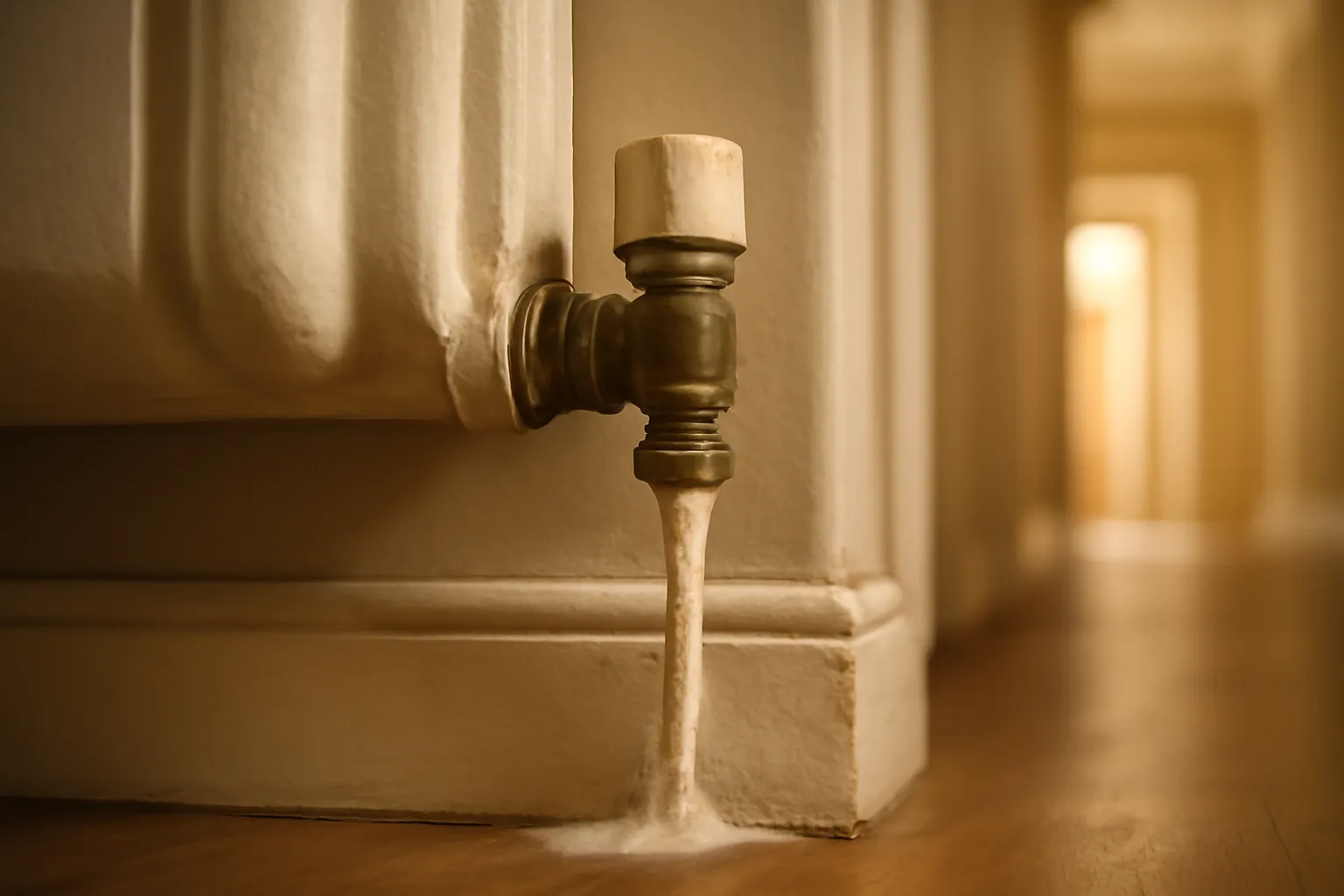
Radiators and valves — Run your hand along the bottom of each radiator and around both valves (the lockshield and the thermostatic head). Even a tiny weep will leave a chalky white tide mark or slight dampness on the floor covering beneath.
Visible pipework — Look at any exposed pipework in the airing cupboard, under the boiler, and beneath kitchen or bathroom units. Check compression fittings and push-fit joints especially.
The boiler itself — Open the front panel if it lifts off easily. Look for drips, rust staining, or limescale deposits around the pump, heat exchanger connections, and the automatic air vent.
The pressure relief valve discharge pipe — This is usually a 15 mm copper pipe that exits through an outside wall and terminates above a drain or onto a visible surface. If it is dripping or discharging, the PRV is releasing excess pressure — either because the boiler is overheating or because the valve has failed.
Step 2: Isolate Sections to Narrow It Down
If nothing obvious shows up, a plumber will systematically isolate sections of the circuit to identify which zone is losing pressure. This involves closing off groups of radiators and monitoring whether the pressure stabilises. When it does, the fault is within the isolated section.
This is not something to attempt without a proper understanding of the system, but it explains why a diagnostic visit is often necessary even when there is no visible puddle.
Step 3: Look for the Signs of a Concealed Leak
Hidden leaks behind plasterboard or under screed floors are harder to spot, but they leave clues:
- Damp patches or bubbling paint on walls or ceilings, particularly on upper floors where pipework runs between joists
- Warm spots on a solid floor that do not correspond to underfloor heating — this can indicate a leaking pipe buried in the screed
- A musty smell in a room with no obvious source
- Carpet that feels slightly damp or has developed mould underneath
A plumber can use thermal imaging or moisture detection equipment to confirm a concealed leak without unnecessary destruction.
Step 4: Do Not Keep Re-Pressurising and Ignoring It
It is tempting to top up the system via the filling loop and carry on. Resist this. Every time you add fresh water you introduce dissolved oxygen and minerals into the circuit. Over time this accelerates internal corrosion, damages the pump, and can cause magnetite sludge to build up. A small leak left unattended can also cause structural damage to your home if it is concealed.
If you are topping up more than once a fortnight, treat it as an active fault that needs attention — not a routine maintenance task.
When to Call an Emergency Plumber
Call us immediately if:
- The boiler has locked out and will not restart after re-pressurising
- You can see water actively dripping inside the boiler casing
- There is water coming through a ceiling or soaking into a floor
- The pressure relief valve is continuously discharging
- You can smell damp or see mould spreading rapidly
These situations can escalate quickly — water finding its way to electrical fittings or structural timbers is a serious risk.
We Cover the TW Area Around the Clock
If your heating pressure is dropping and you cannot find the source, our engineers work across Twickenham, Richmond, Teddington, Isleworth, Hounslow, Feltham, Staines and the surrounding TW postcodes, day and night.
Call us on 07360 268948 and we will help you find the leak and get your heating back to full pressure safely.