Emergencies
Why Is My Boiler Making Banging or Kettling Noises?
Boiler banging or kettling explained: causes, what you can safely check yourself, and when to call an emergency plumber in the TW area.
Published 1 July 2026
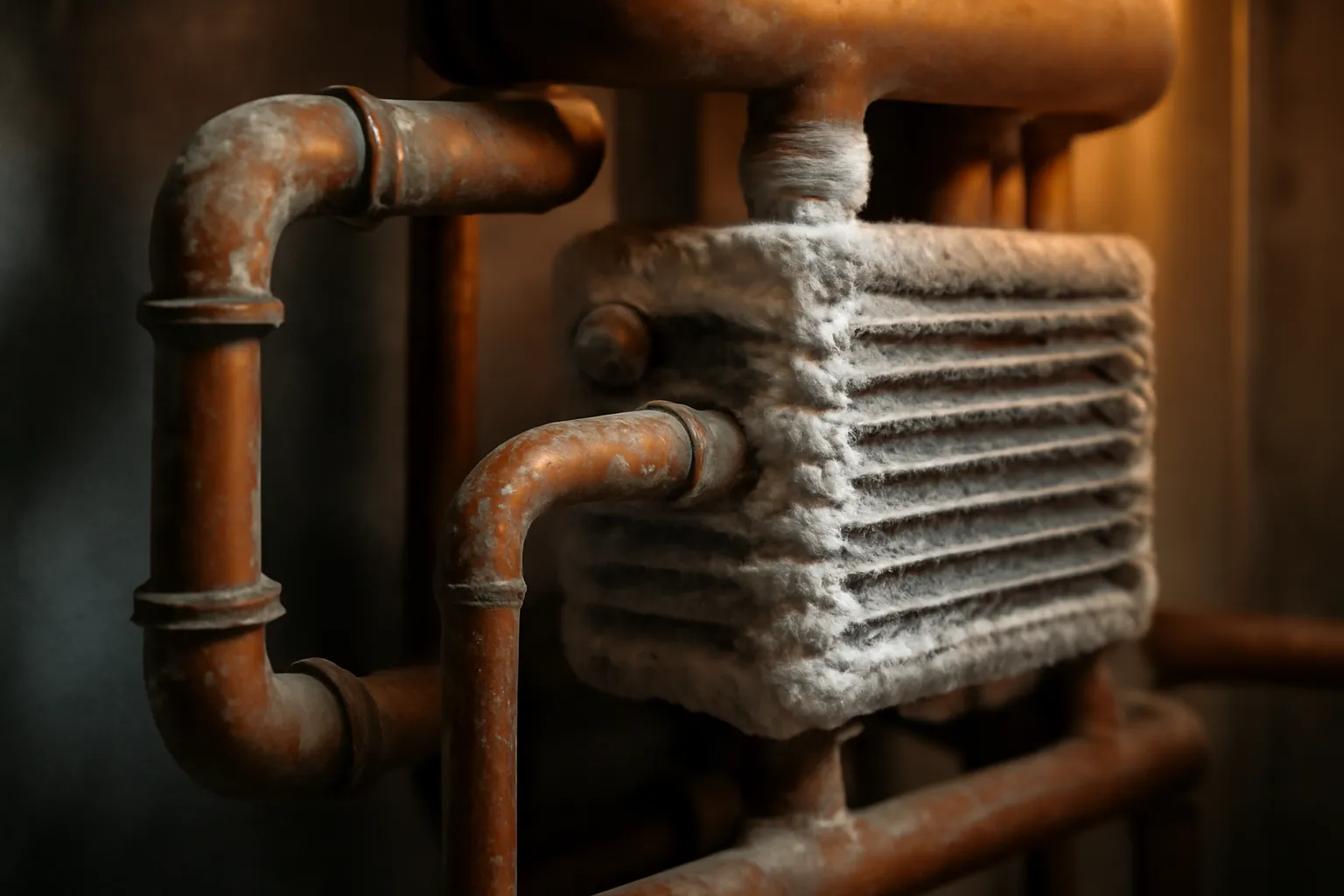
A boiler that starts banging, rumbling, or making a high-pitched kettling sound is trying to tell you something. Most of the time the cause is straightforward, but a few scenarios do need prompt attention. Here is a plain-English guide to what is likely going on and what to do next.
What Does “Kettling” Actually Mean?
Kettling is the term used when a boiler makes a low rumbling or whistling noise — very similar to a kettle coming to the boil. It happens when water inside the heat exchanger gets too hot and partially turns to steam before it can circulate around the system. The noise is the steam bubbling and collapsing as it hits cooler water.
It is not an immediate emergency, but it does put extra stress on your heat exchanger and, left alone, can shorten the life of your boiler considerably.
Common Causes of Boiler Noise
1. Limescale Build-up on the Heat Exchanger
This is the most frequent culprit, especially in hard-water areas like much of the TW postcode. Limescale acts as an insulator, causing localised hot spots where water overheats and kettles. A heating engineer can treat this with a descaling agent or a power flush.
2. Sludge in the System
Over time, corroded pipework and radiators shed iron oxide — a dark, muddy sludge — into the system water. This restricts flow and causes uneven heating, leading to banging and rumbling. A power flush and inhibitor dose usually resolves it.
3. Trapped Air (Airlock)
Air pockets in the system can cause banging or gurgling as water tries to push past them. You may also notice cold spots at the tops of radiators.
What you can safely try yourself:
- Bleed your radiators using a radiator key, starting with the ground floor and working upward.
- Check the boiler pressure gauge afterwards — it should read between 1 and 1.5 bar when cold. If it has dropped below 1 bar, top it up via the filling loop (your boiler manual will show you how).
- If the noise improves after bleeding, you have likely solved it.
4. Pump Issues
The circulation pump moves hot water around your heating system. If it is set too fast, failing, or partly blocked with sludge, it can produce a banging or vibrating noise. This is a job for a qualified plumber or heating engineer — do not attempt to adjust or open the pump yourself.
5. Loose or Vibrating Pipes
Pipes that are not properly clipped can knock against joists or walls as they expand and contract with heat. This usually sounds like a rhythmic ticking or banging that follows a pattern when the heating first comes on. It is generally harmless but can be fixed by securing the pipework.
6. Low Water Pressure
If your boiler pressure has dropped too low, the unit may struggle to circulate water properly, leading to overheating and noise. Check the gauge on the front of your boiler.
Is the Noise a Sign of Danger?
Most boiler noises are a nuisance rather than an immediate hazard. However, call a professional without delay if you notice any of the following alongside the noise:
- A smell of gas or sulphur — leave the property, do not use any switches, and call the Gas Emergency Service on 0800 111 999 immediately.
- Water leaking from the boiler casing or the pipes around it.
- The boiler cutting out repeatedly or displaying a fault/lockout code.
- Banging so loud or sudden that it feels like a pressure event rather than a rattle.
What to Tell Your Plumber
When you call, it helps to have the following ready:
- The make and model of your boiler (usually on a label on the front)
- What the noise sounds like and when it started
- Your current boiler pressure reading
- Whether you have bled the radiators recently
Preventing the Problem in Future
- Annual boiler service — a Gas Safe registered engineer will clean the heat exchanger and check all components before small issues become expensive ones.
- System inhibitor — a chemical added to the system water that slows corrosion and sludge formation.
- Magnetic filter — a device fitted to the return pipe that captures iron oxide particles before they circulate.
Still Not Sure? Give Us a Call
If you have bled the radiators, the pressure looks fine, and the noise is still there — or if you are seeing any of the warning signs listed above — it is worth getting a professional to take a look. Catching a heat exchanger problem early is far cheaper than replacing one.
Emergency Plumbers TW are available 24 hours a day, 7 days a week across Twickenham, Teddington, Richmond, Hounslow, Feltham, Staines and the surrounding TW postcode area.
Call us any time on 07360 268948 and we will talk you through what to do.