Emergencies
Tree Roots in Drains: How They Get In and What Removal Really Costs
Tree roots blocking your drain in TW? Learn how roots enter clay pipes, what removal involves, and why a one-off unblock rarely solves it for long.
Published 18 July 2026
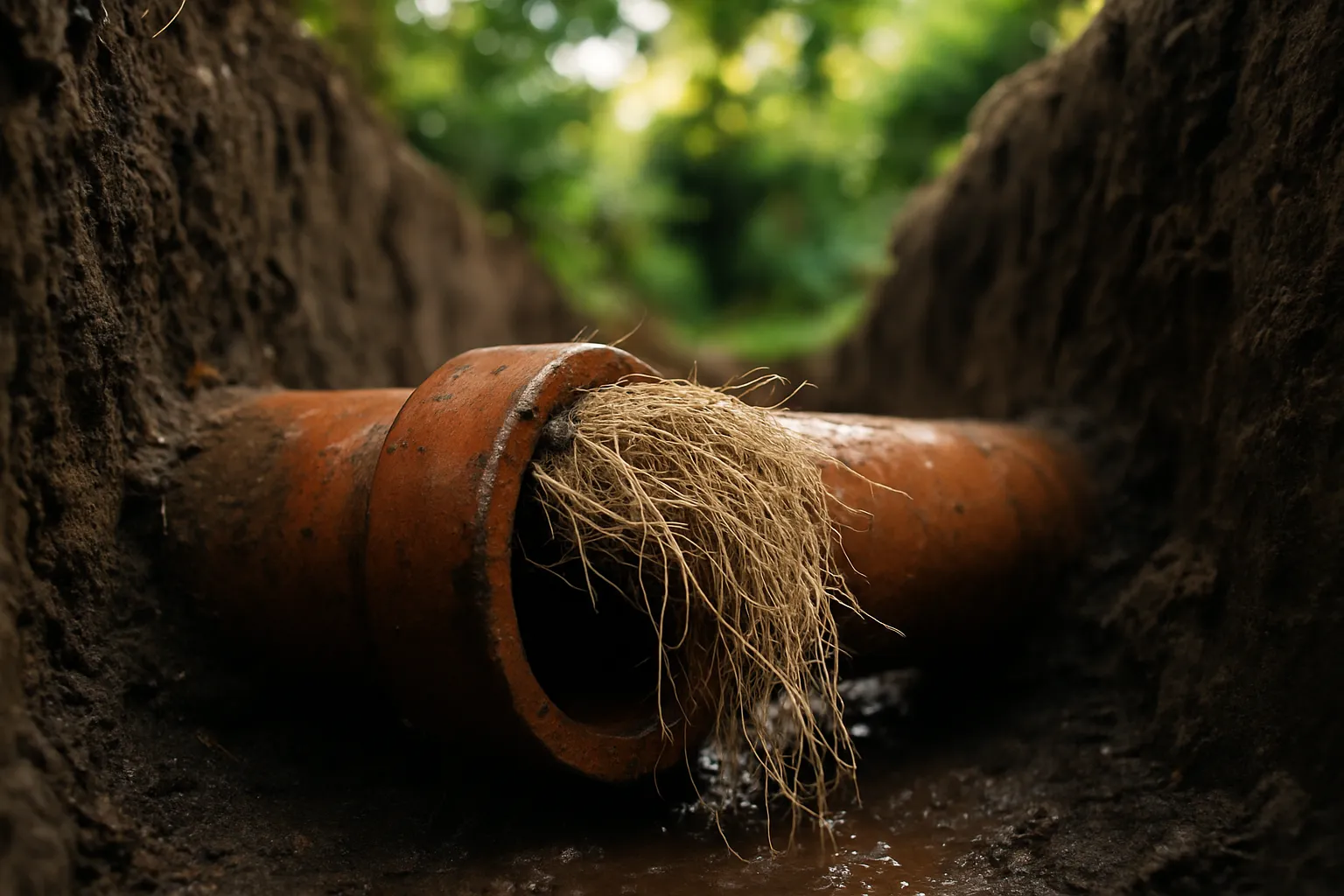
If you live in Teddington, Twickenham, Richmond or any of the leafier parts of the TW postcode, you almost certainly have mature trees nearby. Those trees are beautiful — and they are quietly hunting your drains. Root ingress is one of the most common causes of persistent blockages in this area, and it is one of the few problems where a simple unblock will only buy you a little time.
Why Roots Target Drains
Tree roots follow moisture. Underground, the warm, nutrient-rich water that seeps from a drain joint is like a beacon. Even a hairline crack or a slightly misaligned collar on an old clay pipe releases enough vapour to attract fine root tendrils. Once a tendril finds its way inside, it thickens, branches, and eventually forms a dense mat that traps grease, wipes, and debris — and the blockage builds from there.
Older properties in Teddington and the surrounding TW area very commonly have original clay pipework. Clay pipes are not inherently weak, but their push-fit joints do shift over decades of ground movement, seasonal soil expansion, and the weight of vehicles overhead. Those shifted joints are exactly where roots get in.
Which Trees Are the Worst Offenders?
Almost any tree with an aggressive root system can cause problems, but in this area the usual suspects are:
- Willows and poplars — notorious for seeking water over long distances
- Ash and sycamore — fast-growing roots that exploit the smallest gaps
- Mature oaks — slower but the roots are powerful once established
- Cherry and ornamental plum — common in suburban gardens, often underestimated
The tree does not need to be in your garden. Roots from a neighbour’s tree or a street tree can travel several metres to reach your pipework.
How Root Removal Actually Works
Step 1 — CCTV Survey
Before anything else, a camera survey is essential. It shows where the roots are, how extensive the ingress is, and — crucially — the condition of the surrounding pipe. There is little point cutting roots out of a pipe that is already structurally compromised.
Step 2 — Mechanical Cutting (Rodding or Jetting)
For moderate root ingress, a high-pressure water jetter or a mechanical cutting head can clear the blockage and shave roots back to the pipe wall. This restores flow quickly. The limitation is that it does not seal the entry point. Roots regrow. In a healthy, well-watered garden they can return to a blocking size within one to three years.
Step 3 — Pipe Relining
Relining is the longer-term answer for most situations. A flexible resin-impregnated liner is inserted through an access point, inflated against the pipe wall, and cured in place. The result is effectively a smooth new pipe inside the old one, with no joints for roots to exploit. It does not require excavation in most cases, which keeps disruption and cost down considerably.
Step 4 — Excavation and Replacement
Where a pipe has collapsed, badly offset joints, or multiple fractures, relining may not be viable. In those cases the damaged section needs to be dug out and replaced. This is more disruptive and more expensive, but it is sometimes the only durable fix.
What Does It Cost?
We will not quote specific prices here because every job is different — pipe depth, access, length of affected run, and the extent of root growth all affect the final figure. What we can tell you honestly is:
- A CCTV survey is always money well spent before committing to any remedial work
- Jetting alone is the cheapest option upfront but the most likely to need repeating
- Relining costs more initially but is often cheaper over five to ten years than repeated clearing
- Excavation is the highest cost, but sometimes unavoidable
Get a written quote that separates the survey, the clearance, and any remedial work so you can compare properly.
Why It Always Comes Back If You Only Unblock
This is the key point. Cutting roots restores flow. It does not close the gap in the pipe. The moment moisture starts seeping from that joint again — which it will — the root system begins regrowing toward it. Many householders have the same drain cleared every year or two for years before discovering that a one-off reline would have paid for itself already.
If your drain has blocked more than once and you have mature trees nearby, ask for a CCTV survey before accepting a simple unblock. The camera footage will tell you whether you are dealing with a one-off blockage or an ongoing structural problem.
What You Can Do Right Now
If your drain is slow or has stopped flowing altogether:
- Do not use chemical drain cleaners — they are ineffective against roots and can damage older pipes
- Avoid flushing anything further — it will add to the blockage
- Check your external inspection chamber if you have one — a chamber full of water confirms a blockage downstream
- Call a drainage professional for a proper diagnosis before the blockage causes a back-up into the property
A slow drain caused by tree roots will not clear itself, and the longer it is left, the more debris accumulates around the root mass. If you are in Teddington or anywhere across the TW postcode and you are dealing with a persistent or sudden blockage, give us a call any time — day or night — on 07360 268948. We can get a camera in the drain, show you exactly what is happening, and talk you through the options without any pressure.
Root cutting and relining in the TW area is done by our sister drainage firm Drainiacs. Their guide to tree roots versus clay pipes shows what the camera finds.