Emergencies
Blocked Drains Outside — Whose Responsibility Is It in TW?
Find out who is responsible for a blocked outside drain in the TW area — you, Thames Water, or a neighbour — and what building insurance typically covers.
Published 3 August 2026
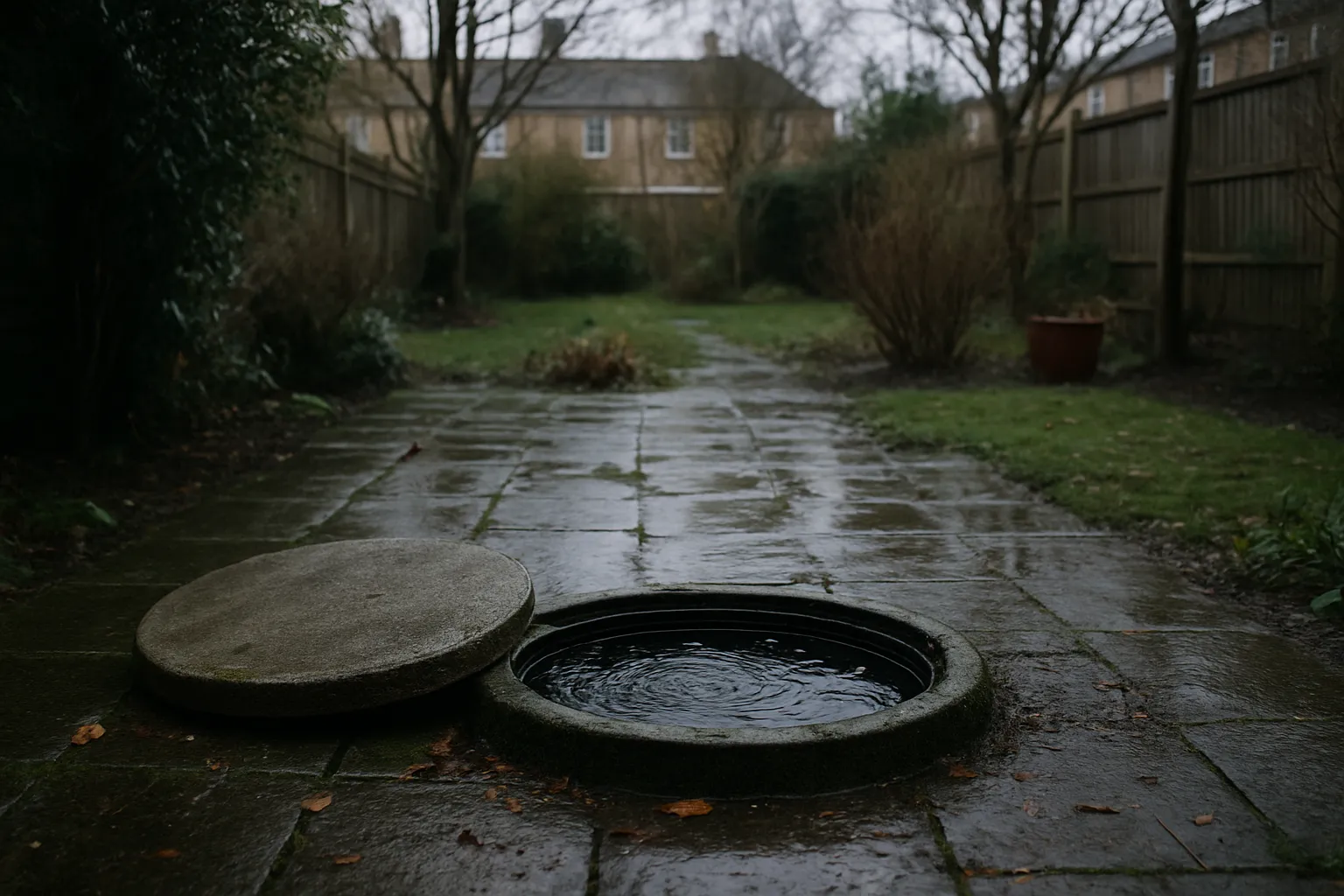
A blocked outside drain is one of those problems that seems simple until you start asking who should fix it. The answer depends on exactly where the blockage sits, whether you share the drain with a neighbour, and what your buildings insurance policy says. Here is a plain-English guide for homeowners across the TW postcodes — Twickenham, Teddington, Richmond, Hounslow, Feltham, Staines and the surrounding area.
The Basic Rule: Private Drain vs Lateral Drain vs Public Sewer
The responsibility question hinges on a boundary that most people never think about until something goes wrong.
Your private drain
Any drain that runs solely within your property boundary and serves only your home is your responsibility. If it blocks, you pay to clear it. This includes gully drains in your garden, the underground pipe running from your kitchen or bathroom to the boundary of your plot, and any inspection chambers that sit entirely within your land.
The lateral drain
Once a drain crosses your boundary and continues underground — even if it still serves only your property — it becomes what the Water Industry Act calls a lateral drain. Since October 2011, lateral drains in England and Wales transferred to the ownership of sewerage undertakers. For the TW area, that means Thames Water.
In practical terms: if the blockage is in the section of pipe beyond your property boundary, Thames Water is responsible for clearing it. You can report it to them at no cost to you.
A shared private drain (private sewer)
If a single underground pipe collects wastewater from two or more properties before it reaches the public sewer — and the blockage is in that shared section — it also transferred to Thames Water in 2011. Before 2011, shared private sewers were the joint responsibility of every property connected to them, which caused enormous disputes. The 2011 transfer removed that headache for most homeowners.
How to Work Out Which Applies to You
- Lift the inspection chamber nearest to your house. If it is clear, the blockage is likely further downstream — possibly in the lateral drain or public sewer.
- Check where your boundary is. The blockage point relative to your fence or wall is the key question.
- Ask Thames Water. They have sewer maps and can tell you within a few minutes whether a given pipe is adopted. Call their 24-hour line or use their online checker.
What About Buildings Insurance?
This is where homeowners often get confused. Here is what policies typically do and do not cover — though your specific policy wording always takes precedence, so read it carefully or speak to your insurer directly.
What is often covered
- Sudden and unforeseen damage to underground drainage pipes — for example, a pipe that has cracked or collapsed due to ground movement or root intrusion.
- The cost of excavation and reinstatement of driveways or garden areas to access a damaged pipe.
- Some policies include trace and access cover as standard or as an add-on.
What is often not covered
- Blockages caused by gradual build-up of grease, scale, or debris — insurers typically treat this as a maintenance issue.
- Damage caused by neglect or lack of maintenance.
- Pipes that are the responsibility of Thames Water or another utility.
What evidence your insurer will usually ask for
If you need to make a claim for drain damage, your insurer or loss adjuster will typically want:
- Photographs of the affected area and any visible damage
- A written report from the attending plumber or drainage engineer stating the cause of the problem
- CCTV drain survey footage or a written description of findings
- Moisture readings if there is internal water damage
- Receipts or invoices for any emergency work carried out
Gathering this evidence is your responsibility as the policyholder. A good drainage engineer will provide you with a written cause-and-condition report, photographs, and (where a CCTV survey is carried out) footage — all of which belongs to you to use as you see fit when dealing with your insurer.
Common Scenarios in the TW Area
Terrace and semi-detached homes in Twickenham and Hounslow often have shared private sewers running under rear gardens. These are almost certainly Thames Water’s responsibility now.
Larger detached properties in Richmond and Teddington may have longer private drain runs before reaching the public sewer. The section within your boundary is yours.
Older properties in Feltham and Staines sometimes have clay or pitch-fibre pipes that are more prone to root intrusion and cracking — worth a CCTV survey if you are having repeated blockages.
What to Do Right Now
If your outside drain is blocked and water is backing up:
- Do not use water-hungry appliances (washing machine, dishwasher) until the blockage is cleared.
- Lift your nearest inspection chamber to see whether it is full — this tells you whether the blockage is upstream or downstream of that point.
- Check with Thames Water whether the pipe is adopted before spending money on a clearance that may be their job.
- If the drain is your responsibility, or you need an urgent clearance while you establish responsibility, call a local drainage engineer.
If you have a blocked outside drain that needs clearing now — or you want a written condition report for insurance purposes — call Emergency Plumbers TW any time on 07360 268948. We are available 24 hours a day across the TW postcodes and will give you a clear written record of what we find and what we do.
The deciding factor is usually whether the pipe is a lateral or a private drain. Our sister drainage firm Drainiacs explain the lateral drain versus private drain difference.