How-to
Soakaways Explained: Signs Yours Has Failed and What Replacement Costs
Boggy lawn after rain? Learn how soakaways silt up, how to test yours, and what replacement costs look like in the TW area.
Published 21 July 2026
What Is a Soakaway and Why Does It Matter?
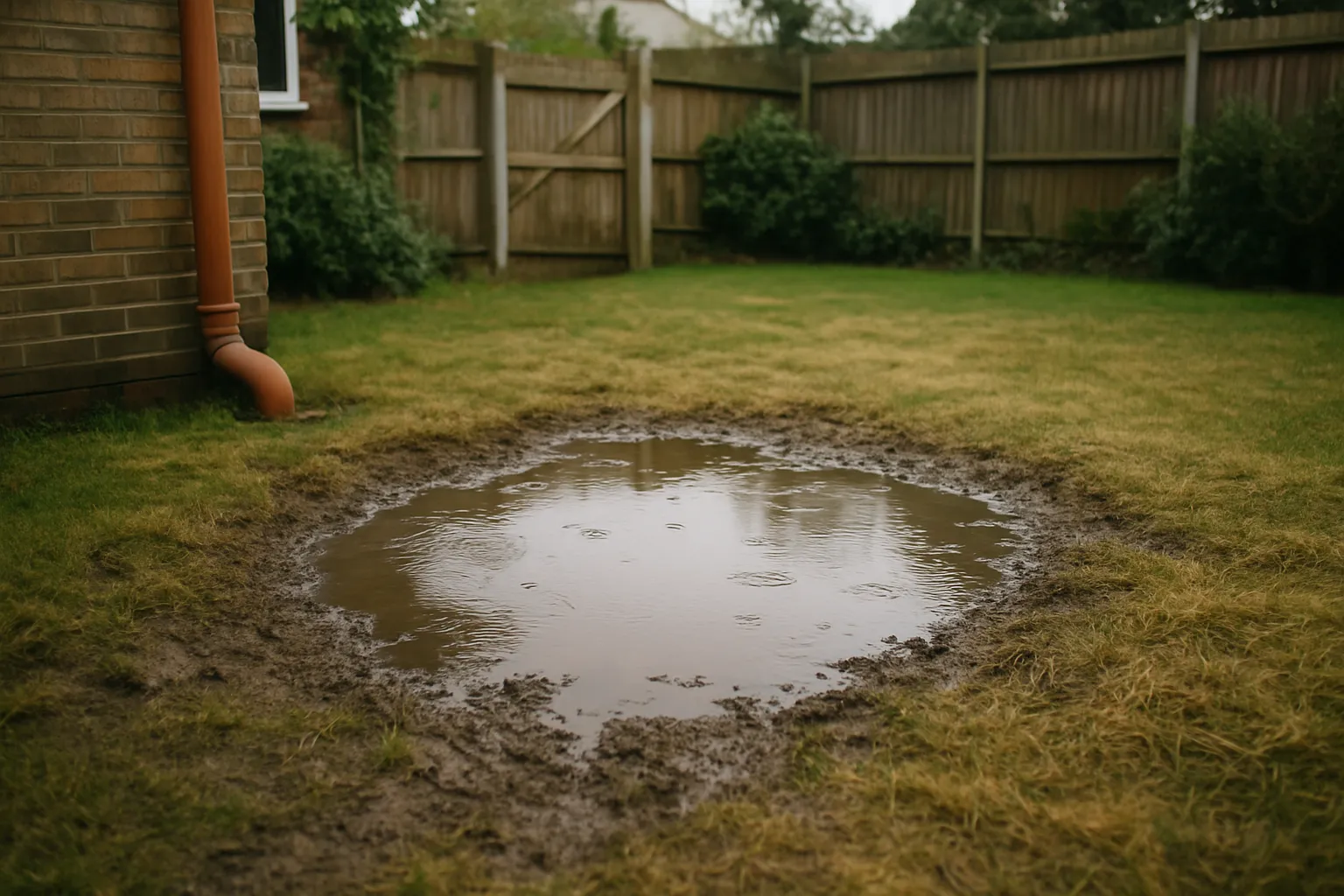
A soakaway is a buried pit — traditionally filled with rubble, or more recently lined with plastic crates — that collects surface water and rainwater from your roof gutters, then allows it to percolate slowly into the surrounding soil. In suburban gardens across the TW postcode area, soakaways are one of the most common forms of surface-water drainage, particularly on properties built before mains surface-water sewers became standard.
When a soakaway works well, you barely know it exists. When it fails, the symptoms are hard to miss.
Signs Your Soakaway Has Failed
1. Persistently Waterlogged or Boggy Patches
The most obvious sign is a patch of lawn that stays wet long after rainfall has stopped — sometimes days longer than the rest of the garden. If you notice a roughly circular or rectangular boggy area, that often corresponds directly to where the soakaway pit sits underground.
2. Slow or Backing-Up Gutters and Downpipes
If your downpipes drain into the soakaway and you notice water pooling at the base of the pipe, or gutters overflowing during moderate rain, the soakaway may no longer be accepting water fast enough.
3. Damp Appearing Near the House Foundations
A failed soakaway positioned too close to the house can force water back towards the building. If you are seeing damp patches on an external wall or in a basement, the soakaway is worth investigating alongside other causes.
4. Visible Subsidence or a Sunken Patch of Lawn
Older rubble-filled soakaways can collapse inward as the surrounding soil shifts. A sunken, slightly hollow area of lawn is a warning sign worth acting on before it becomes a safety hazard.
Why Soakaways Silt Up
Every time rainwater passes through a soakaway, it carries fine particles of silt, clay and organic matter with it. Over time — typically 20 to 30 years for a rubble-filled pit, though sometimes sooner in clay-heavy soils — those particles clog the voids between the rubble or the perforations in a plastic crate system. Once clogged, the soakaway simply cannot drain water away fast enough.
Clay soils, common across parts of Ashford, Feltham and Hounslow, are particularly unforgiving. They drain slowly even when a soakaway is new, and they accelerate silting. If your garden sits on heavy clay, a soakaway may have a shorter useful life than average.
Testing Your Soakaway
A basic percolation test will tell you whether the ground around the soakaway can still absorb water at a useful rate. Here is a simplified version you can carry out yourself:
- Dig a small test hole roughly 300 mm square and 300 mm deep near the soakaway.
- Fill it with water and allow it to drain completely. Do this twice to saturate the surrounding soil.
- Fill the hole a third time and time how long it takes to drain completely.
- Divide the time in minutes by 150 mm (the depth of water). A result of 1–100 minutes per 150 mm is generally considered suitable for soakaway drainage.
If the water barely moves after an hour, the soil — or the soakaway itself — is no longer functioning. A drainage specialist can carry out a more thorough assessment, including CCTV survey of any connecting pipework.
Realistic Replacement Costs
Costs vary depending on the size of the soakaway required, depth of excavation, soil type and access to the garden. As a general guide for the TW area:
- Small plastic crate soakaway (1 m³): typically £800–£1,500 fitted, including excavation and backfill
- Medium soakaway (2–3 m³), suitable for a standard semi-detached roof area: typically £1,500–£3,000
- Large or deep soakaway in difficult ground: £3,000 upward, depending on site conditions
These figures are illustrative. Always obtain written quotes from at least two contractors before committing. Bear in mind that planning permission is not normally required for a domestic soakaway, but Building Regulations Part H does set minimum distances — generally 5 metres from a building and 2.5 metres from a boundary.
What Happens If You Leave It?
A failed soakaway does not fix itself. Left unaddressed, the consequences tend to escalate: persistent waterlogging can kill lawn and plants, accelerate fence post rot, and — if the soakaway sits close to the house — contribute to foundation damp. Acting early is almost always less expensive than waiting.
When to Call a Plumber
If your downpipes connect to the soakaway and you are seeing signs of backing up, or if you suspect a collapsed pit is creating a subsidence risk, it is worth getting a professional eye on the problem. A drainage survey can confirm whether the issue is the soakaway itself, the connecting pipework, or both.
If you have an active overflow or flooding situation affecting your property right now, call us on 07360 268948 — we are available 24 hours a day, seven days a week across the TW area and can help stabilise the situation while you arrange a longer-term drainage solution.
Soakaway replacement and drain repair in the TW area is carried out by our sister drainage firm Drainiacs. See their drain repair and relining service.