Emergencies
Boiler Making Banging or Kettling Noises: The Real Fixes
Banging or kettling from your boiler is usually a pressure or limescale problem. Here is how to diagnose it and what to do right now.
Published 29 July 2026
Why Is Your Boiler Making That Noise?
A banging, rumbling, or kettling boiler is one of the most common calls we receive across the TW postcode area. The good news is that the cause is almost always one of two things: incorrect system pressure or limescale build-up on the heat exchanger. Neither should be ignored, but understanding which one you are dealing with helps you take the right action quickly.
The Pressure Connection
Your boiler has a pressure gauge — usually a dial or a digital readout on the front panel. For most combination and system boilers, the healthy operating range when the system is cold is 1.0 to 1.5 bar. Some manufacturers allow up to 2.0 bar when hot.
Boiler Low Pressure
If the gauge reads below 1.0 bar, you have low boiler pressure. Symptoms include:
- Banging or clunking as the pump struggles to circulate water
- Radiators that are warm at the bottom but cold at the top
- The boiler locking out and showing a fault code
- Hot water that runs lukewarm rather than hot
Low pressure boiler fix — step by step:
- Locate the filling loop — a short braided hose or valve, usually beneath the boiler.
- Open the valve(s) slowly until the pressure gauge climbs to around 1.2 bar.
- Close the valve(s) firmly. Do not overfill.
- Reset the boiler using the reset button.
- Monitor the gauge over the next few days.
If the pressure keeps dropping back down, you likely have a small leak somewhere in the system — a radiator valve, a joint behind the wall, or the boiler’s pressure relief valve itself. A recurring low pressure problem needs a plumber to investigate properly.
Boiler Pressure Too High
If the gauge reads above 2.5 bar, the system is over-pressurised. This can cause:
- Loud banging and knocking sounds
- The pressure relief valve discharging water outside (look for a damp patch near an external pipe)
- The boiler cutting out on a high-pressure fault
Do not attempt to bleed radiators to reduce pressure unless you are confident doing so. If the gauge is above 3.0 bar or the relief valve is actively discharging, turn the boiler off and call a plumber. Over-pressurisation can damage the heat exchanger and seals.
Kettling: The Limescale Story
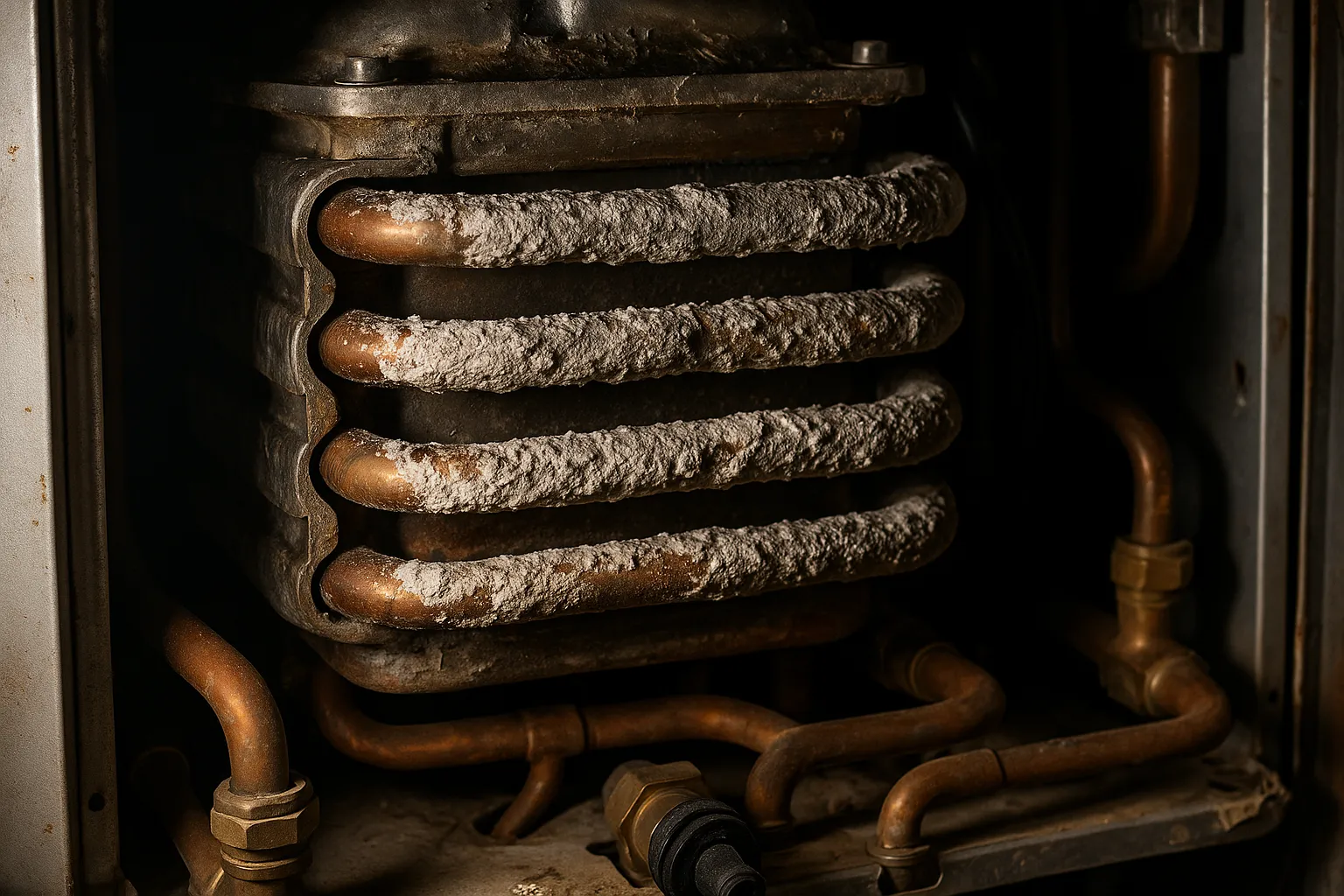
Kettling is a lower-pitched rumbling or bubbling noise, similar to a kettle boiling. It is caused by limescale or sludge coating the heat exchanger. In hard-water areas — and the TW area sits in one of the hardest-water regions in England — this is very common.
Scale acts as an insulator. Water trapped behind the deposit overheats locally, creates steam bubbles, and collapses them noisily. The fix is a power flush or a chemical descale, depending on severity. A magnetic system filter fitted afterwards protects against future sludge build-up.
Kettling will not go away on its own, and it forces the boiler to work harder, raising energy bills and shortening the heat exchanger’s life.
Other Causes of Boiler Banging
If pressure and limescale checks do not explain the noise, consider:
- Trapped air — bleeding your radiators can help, but if air keeps returning, there may be a leak drawing air into the system.
- Pump failure or a failing pump bearing — a grinding or rattling noise that changes with pump speed.
- Loose pipework — pipes that expand when hot can knock against joists or brackets.
- Faulty diverter valve — on combination boilers, a sticky diverter valve can cause banging when switching between heating and hot water.
When to Call a Plumber Immediately
Call us straight away if:
- The pressure gauge is above 3.0 bar or the relief valve is discharging
- You smell gas or suspect a gas leak (call National Gas Emergencies on 0800 111 999 first)
- The boiler is making a loud single bang rather than a continuous noise
- The boiler has locked out and will not reset
- You can see water leaking from the boiler casing
Quick-Reference: Pressure Ranges
| Gauge reading (cold) | What it means | Action |
|---|---|---|
| Below 0.5 bar | Very low — boiler may lock out | Repressurise via filling loop |
| 0.5 – 1.0 bar | Low — top up needed | Repressurise carefully |
| 1.0 – 1.5 bar | Normal | No action needed |
| 1.5 – 2.5 bar | Slightly high when hot | Monitor |
| Above 2.5 bar | Over-pressurised | Call a plumber |
| Above 3.0 bar | Unsafe | Turn off boiler, call immediately |
Still Not Sure? We Can Help
A banging or kettling boiler is telling you something is wrong. Most pressure issues take a qualified plumber under an hour to diagnose and resolve. Limescale problems take a little longer but are entirely fixable.
If you are in Twickenham, Richmond, Teddington, Hounslow, Feltham, Staines, Isleworth or anywhere else in the TW area, we are available around the clock.
Call Emergency Plumbers TW any time: 07360 268948